From Petrol and Diesel to Essential Commodities, Chandrababu Government is Squeezing Every Household
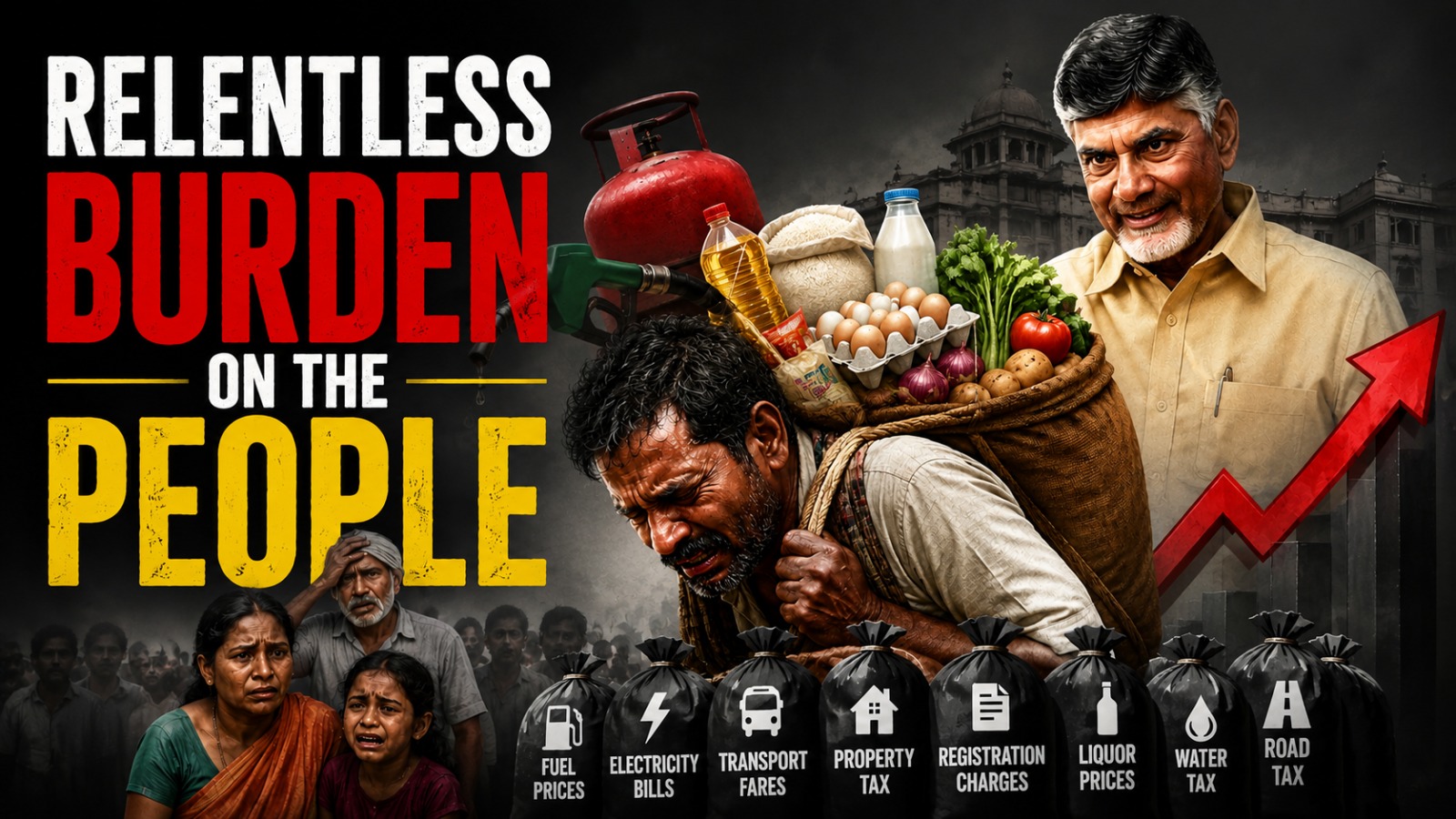
- Rising fuel prices, soaring prices of essential commodities, increased power tariffs, higher APSRTC fares, road taxes, user charges in Amaravati, steep registration charges, higher liquor prices, taxes on drinking water in villages, fees on walkers, and new lifetime taxes on vehicles — this has become the defining feature of governance under Chief Minister Chandrababu Naidu.
- Instead of providing relief to people, the government has imposed one burden after another, making daily life increasingly difficult for ordinary families. The cost of living has risen sharply, pushing people into financial distress.
Is this what Chandrababu calls Wealth creation?
Before the elections, Chandrababu Naidu travelled across the State promising “wealth creation,” lower fuel prices, no increase in power tariffs, reduced burdens on citizens, and enhanced welfare benefits. Two years later, the reality is entirely different.
Petrol and diesel prices remain high despite repeated promises of reduction. Power tariffs have been increased repeatedly, extracting nearly Rs. 20,000 crore from consumers. Registration charges have been sharply increased. Additional lifetime taxes have been imposed on vehicle owners. User charges have been introduced in Amaravati. Villagers are being forced to pay for drinking water. Liquor prices remain high despite promises of reduction. Even walkers using public facilities in Visakhapatnam have not been spared from new fees.
People across all sections of society are asking: Where is the promised relief?
Questions the Government Must Answer
- What happened to the promise of reducing petrol and diesel prices?
- Why were power tariffs increased despite promises to the contrary?
- Why were registration charges increased by such large margins?
- Why has the burden on vehicle owners been increased?
- Why are rural families being charged for drinking water?
- Why are user charges being imposed in Amaravati?
- Why are walkers being charged fees to access public facilities?
- Why were liquor prices not reduced as promised?
- What measures have been taken to increase people’s incomes?
- Why were the Super Six and Super Seven promises abandoned?
APSRTC Fare Burden
The Y.S. Jagan Mohan Reddy government merged APSRTC with the State Government and regularised nearly 52,000 employees. Today, the Chandrababu government is moving towards privatisation.
Under various pretexts, including losses arising from free bus travel schemes and the procurement of electric buses, efforts are underway to hand over APSRTC operations to private entities. Simultaneously, the government has proposed a fare increase of Rs. 5.72 per kilometre, which would impose an additional burden of nearly Rs. 300 crore annually on passengers.
Essential Commodities Becoming Unaffordable
Prices of essential commodities have skyrocketed across Andhra Pradesh. From salt and pulses to vegetables and cooking oil, household expenses have increased dramatically.
The prices of several commodities have risen by 20% to 40%, placing severe strain on family budgets. People are increasingly finding it difficult even to afford basic meals, while monthly price increases continue to erode purchasing power.
Fuel Price Burden
Before the elections, Chandrababu Naidu repeatedly promised to reduce petrol and diesel prices. While in opposition, he organised protests demanding lower fuel prices and publicly declared that his government would provide relief.
Today, those promises have been abandoned. Despite fluctuations in fuel prices and mounting public hardship, the government has not taken meaningful steps to reduce state-level taxes and provide relief to consumers.
Power Tariff Shock
Before assuming office, Chandrababu Naidu repeatedly promised that electricity tariffs would not be increased. After coming to power, however, the coalition government imposed a series of tariff hikes.
Within less than two years, consumers have been burdened with nearly Rs. 19,000 crore in additional electricity charges. Despite claiming that no fresh burden is being imposed, power consumers continue to face higher bills.
The Andhra Pradesh Electricity Regulatory Commission itself directed that Rs. 923.55 crore collected from consumers be refunded. Yet the government projected this as an act of generosity rather than compliance with regulatory orders.
Registration Charges Hiked
The coalition government substantially increased registration charges across Andhra Pradesh, excluding parts of the Amaravati region.
Property values were revised upward through Sub-Registrar offices, resulting in sharp increases in registration fees. The revised rates came into effect from February 1 and, in many cases, registration charges increased by more than 40–50%.
The move is expected to generate nearly Rs. 13,000 crore in revenue, effectively shifting a significant financial burden onto citizens.
Vehicle Lifetime Tax Burden
After the Central Government reduced GST on several vehicle categories, the Andhra Pradesh Government imposed an additional burden through higher lifetime taxes.
Vehicle owners are now paying significantly more under what critics describe as a new form of taxation, increasing the cost of vehicle ownership at a time when families are already struggling with inflation.
Liquor Price Burden
Chandrababu Naidu promised to reduce liquor prices before the elections. Instead, prices have increased substantially after coming to power.
Official price hikes of around Rs. 10 per bottle have been accompanied by unofficial mark-ups ranging from Rs. 10 to Rs. 20 more, resulting in consumers paying as much as Rs. 30 extra per bottle. Festival seasons have also witnessed arbitrary increases, adding further burden on consumers.
User Charges in Amaravati
World Bank loan documents relating to Amaravati indicate plans to impose extensive user charges on residents and businesses.
Development charges, cess collections, water charges, sanitation charges, drainage charges, and infrastructure maintenance fees are expected to be recovered directly from citizens through a tariff-based system.
This effectively means that residents will be required to pay for the capital city’s infrastructure through recurring user charges.
Drinking Water Tax in Villages
The coalition government is moving towards imposing user charges for drinking water supply schemes in rural areas.
The proposal is expected to place an additional annual burden of approximately Rs. 1,036.97 crore on rural households, triggering widespread opposition from villagers across the State.
Charges Even on Walkers
Until recently, walkers could access facilities at GVMC’s Swarna Bharathi Indoor Stadium, Rajiv Sports Complex, and several other public sports facilities free of cost.
The new policy requires walkers to pay annual fees of Rs. 720 simply for access. Children learning badminton, boxing, and other indoor sports are also expected to pay significantly higher charges.
The move has drawn criticism as another example of the government’s growing reliance on user charges.
A Toll on Every Road
The government’s approach increasingly reflects a philosophy of charging citizens for every public service.
Comments supporting the collection of user charges even on rural roads have raised concerns that people may soon be required to pay additional fees simply for using public infrastructure built with taxpayer money.
No Welfare, Only Burden
Chandrababu Naidu came to power promising welfare programmes superior to those implemented by Y.S. Jagan Mohan Reddy. Instead, the Super Six and Super Seven promises have largely remained unfulfilled.
Several schemes have either been discontinued, diluted, delayed, or partially implemented. Welfare delivery has weakened while new taxes, charges, and financial burdens continue to grow.
Public discussion across Andhra Pradesh increasingly contrasts two governance models: one that transferred benefits directly into the hands of citizens, and another that is seen as extracting money from citizens through a growing network of taxes, tariffs, fees, and user charges.