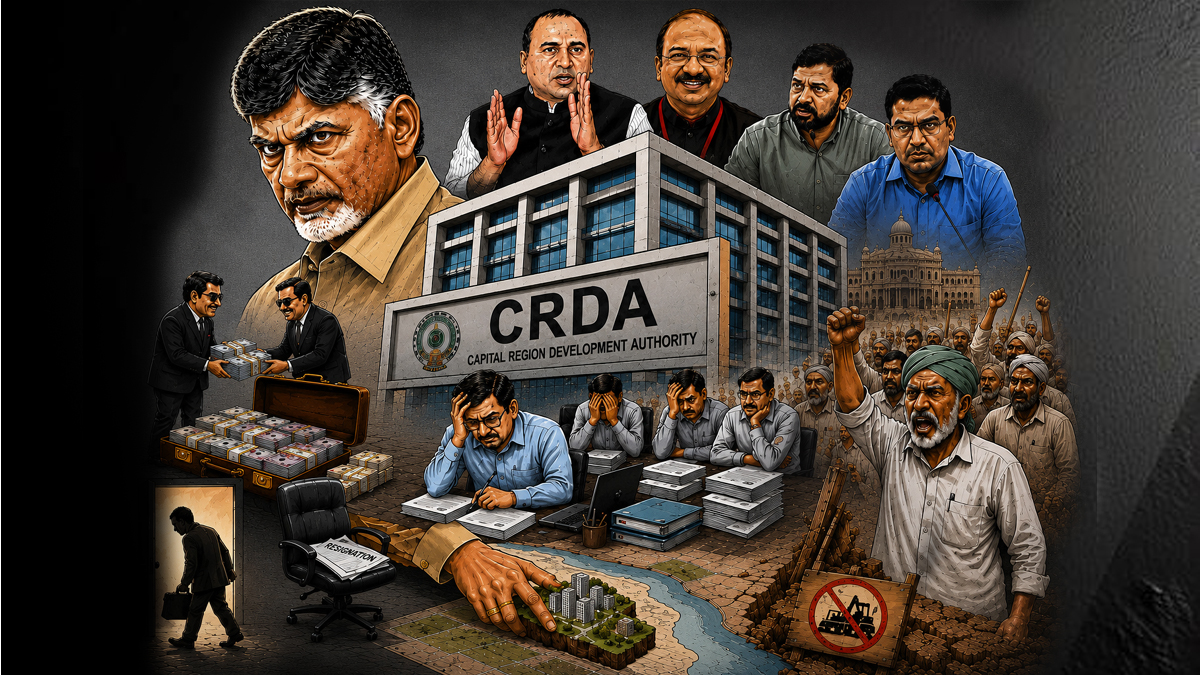
Tadepalli, July 4: Frequent changes in the leadership of the Andhra Pradesh Capital Region Development Authority (CRDA), the resignation of senior officials and growing concerns over land acquisition have once again brought the Amaravati capital project under public scrutiny. Within two years, four CRDA Commissioners have been changed, while the resignation of AGICL Managing Director S.V. Ratna Srinivas has raised further questions over the functioning of the capital development authority.
The rapid changes in CRDA leadership have attracted attention. Vivek Yadav resigned in July 2024. Katamaneni Bhaskar served from July 2024 to January 2025. K. Kannababu was Commissioner from January 2025 until March 2026 before being transferred. V. Vijayarama Raju has been serving as Commissioner since March 2026.
Officials are said to be working under increasing pressure as they deal with land acquisition, implementation of government decisions and persistent questions from farmers. Farmers have been seeking answers on compulsory land acquisition, notices issued under the land pooling process, changes in project plans and the legal procedures being followed.
The resignation of AGICL Managing Director S.V. Ratna Srinivas has also drawn attention. Having handled several key infrastructure works in Amaravati, he stepped down after initially proceeding on leave and later tendering his resignation, adding to speculation over differences relating to project implementation.
The Amaravati project has also come under discussion over its estimated costs. Questions have been raised over the projected construction cost of more than Rs 20,000 per square foot for government buildings when comparable premium buildings elsewhere are built at much lower costs. Similarly, road construction costs of about Rs 54 crore per kilometre are significantly higher than the average expenditure on National Highway projects.
Land acquisition continues to remain one of the most debated issues. While nearly 50,000 acres were already pooled for the capital city, additional acquisition of fertile agricultural land is being pursued. Farmers have questioned the need for further land acquisition and have expressed concern over excavation of agricultural fields, changes in road alignments, reservoir proposals and the impact on cultivation.
Many land pooling farmers say they are still waiting for fully developed return plots nearly a decade after surrendering their lands. They have also questioned changes in layouts, allocation of plots in unsuitable locations and fresh acquisition notices despite earlier legal proceedings. Concerns have also been raised over whether mandatory procedures such as Gram Sabha consultations, Social Impact Assessment studies and other statutory requirements under the land acquisition law have been fully followed.
The financial model of Amaravati has also come under focus. Although the project has been projected as self-financing, borrowings of around Rs 47,000 crore have already been raised. Questions continue over project expenditure, funding patterns and the future debt burden on the State.
Farmers have also sought answers on several unresolved issues, including the continuation of land pooling after its original deadline, compensation for delayed registrations, repeated changes in DPR alignments, acquisition of Penumaka and Undavalli villages, acquisition of additional fertile lands despite the availability of previously pooled land, and the authority under which new notices are being issued.
With frequent changes in senior officials, unresolved concerns of farmers, escalating project costs and growing financial commitments, the Amaravati capital project continues to remain under close public and political scrutiny.