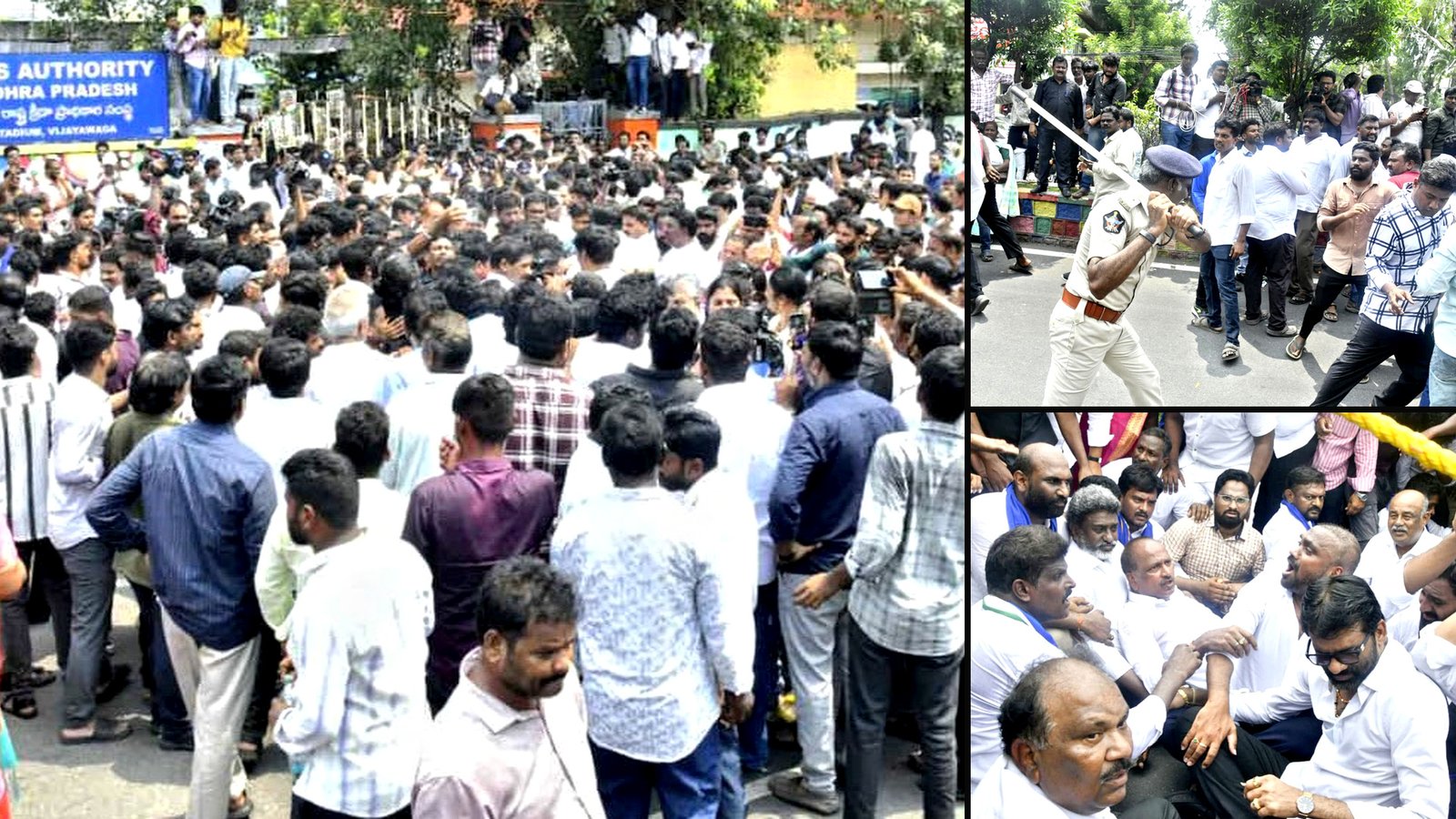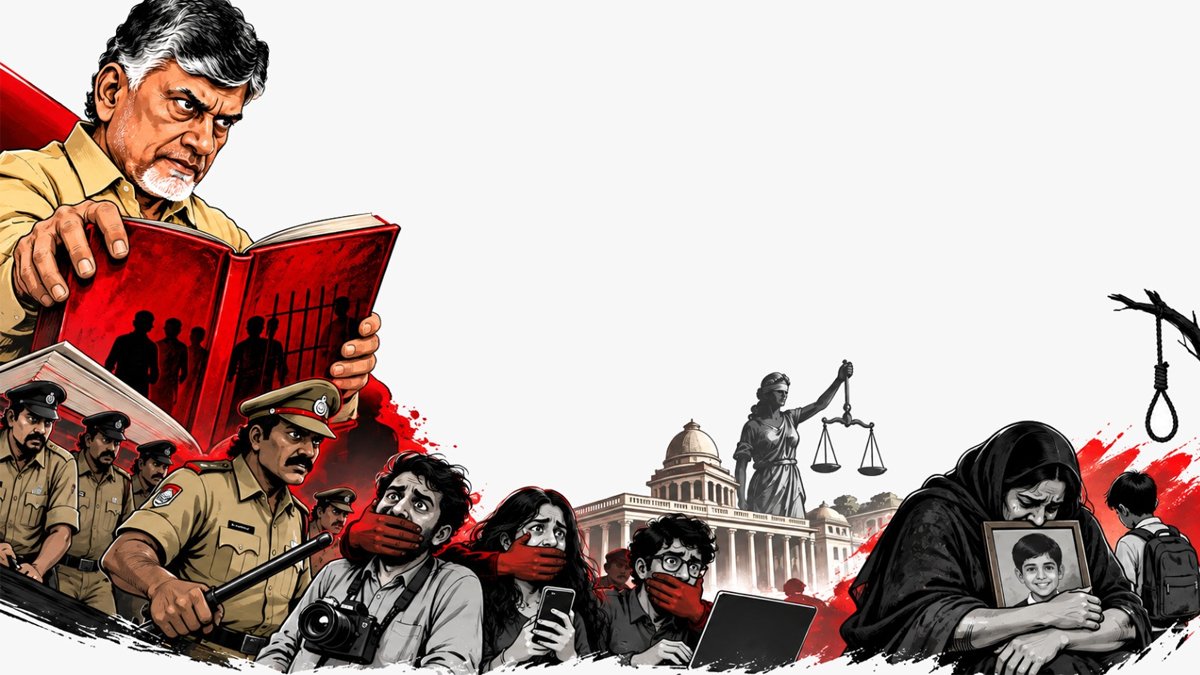
- Some police officers’ excesses claimed the lives of sai krishna, kranthi kumar, gangamma, kalavathi and tirupathamma
- Deaths in police custody… followed by disappearance of bodies
- Who is responsible for these deaths?
- Police stations turning into centers for political vendetta
- Human rights and constitutional safeguards under assault
- Black marks on law and order in the state
- Cinema cameras and news cameras are not the same, pawan
- Pawan’s diversion tactics to shield chandrababu
- Janasena: by chandrababu, for chandrababu, and to protect chandrababu
- Coalition leaders used kapus for elections
- Will pawan not speak when those very kapus face injustice?
- A deputy chief minister must serve the people, not use rowdy language against the opposition
- The people will ultimately teach chandrababu and pawan a lesson
The deaths of Kapu youth Sai Krishna, Madiga youth Kranthi Kumar, Dalit woman Gangamma from Kurnool district, Kalavathi from Vizianagaram district, and Tirupathamma from Srikakulam district, along with reports of custodial deaths and the subsequent disappearance or mishandling of bodies, have deeply shocked the people of Andhra Pradesh. These are not ordinary crime incidents. They involve serious questions relating to police custody, abuse of authority, human rights, constitutional protections, and the safety of Dalits and other vulnerable sections of society. When a person is taken into custody, the government assumes complete responsibility for that individual’s life and safety. A person in custody must remain protected. If that does not happen, it is not merely a tragedy for one family—it becomes a black mark on the law-and-order situation of the entire state.
In these cases, the State Government, the Chief Minister, the Home Minister, the DGP, the Vijayawada Police Commissioner, and other responsible authorities are now obligated to answer the questions being raised by the public. The people are asking simple but fundamental questions: Who is responsible for these deaths? Who took these individuals into custody? Under whose instructions were they taken? Why were their families not informed? Why was there such secrecy surrounding the handling of the bodies? Were mandatory legal procedures such as post-mortems, inquiries, and the rights of family members followed? These are questions that the government can no longer avoid and must answer before the people of Andhra Pradesh.
Public anger mounts over a police system gone off track
There is growing public outrage across Andhra Pradesh over what many see as the collapse of constitutional governance and the breakdown of accountability within the police system. Citizens from all sections of society are demanding that police officials who implemented the so-called “Red Book Constitution” and abused their authority be subjected to legal scrutiny, criminal prosecution, and an independent investigation.
People are increasingly asking a fundamental question: Has the police station remained a place of protection for citizens, or has it become a center for executing political vendettas? Under the law, the responsibility of the police is to safeguard the public. But when ordinary citizens begin to fear the very institution meant to protect them, it ceases to be merely a governance failure and becomes a case of grave governmental negligence.
Pawan kalyan brought in to divert public attention
At a time when the government is facing difficult questions over custodial deaths, police excesses, and missing bodies, there appears to be a deliberate attempt to shift public attention away from these issues. It is in this context that Deputy Chief Minister Pawan Kalyan has suddenly been pushed to the forefront of the political debate. As part of this diversionary exercise, he has resorted to using abusive and confrontational language against YSRCP. Today, even Jana Sena MLA Pantam Nanaji made highly objectionable remarks against Y.S. Jagan Mohan Reddy.
When those in power are unable to answer uncomfortable questions, creating political distractions through personal attacks has long been a political strategy associated with Chandrababu Naidu. Pawan Kalyan is now being used to perform that role.
When the leader crosses the line, followers go further
If Pawan Kalyan chooses to use the language of intimidation and confrontation, his party legislators inevitably go even further. When a leader abandons restraint on public platforms, followers feel emboldened to cross all limits in public discourse. That is precisely what is unfolding today.
There appears to be a calculated strategy in which Pawan Kalyan not only makes provocative statements himself but also encourages his party legislators to do the same, hoping to provoke a strong response from YSRCP. The objective seems clear: transform a serious public debate into a cycle of political abuse and counter-abuse, thereby diverting attention away from the deeply disturbing issues of custodial deaths, missing bodies, and police excesses, including the Sai Krishna case and similar incidents across the state.
YSRCP is asking only a few basic questions: What happened in these custodial death cases? Who is responsible? Why has action not been taken against those involved? When will justice be delivered to the affected families?
Instead of answering these questions, Pawan Kalyan appears determined to continue using inflammatory rhetoric, while encouraging his legislators to do the same, all with the objective of shielding Chandrababu Naidu’s government from accountability.
However, the people of Andhra Pradesh are not naïve. They may hear the insults and political rhetoric, but they have not forgotten the questions that remain unanswered. Ironically, Pawan Kalyan, who once built his political identity around the slogan of questioning those in power, now appears unwilling to face the questions being raised by the people themselves.
Pawan kalyan’s remarks are a deliberate diversion from custodial deaths
When Pawan Kalyan resorts to abusive and confrontational language, his MLAs inevitably go a step further. When a leader abandons civility on public platforms, followers feel encouraged to cross every limit in public discourse. That is exactly what is happening today.
This is not merely about Pawan Kalyan making such statements himself. There appears to be a calculated strategy to have his MLAs make similar provocative remarks, with the intention of provoking a strong response from YSRCP. The objective is to gradually turn the public discourse into a cycle of mutual insults and political mudslinging, thereby diverting attention away from the deeply disturbing issues confronting the state—custodial deaths, police excesses, and the disappearance of bodies, including the Sai Krishna case and other incidents that have shocked public conscience.
YSRCP is asking only a few basic questions: What happened in these custodial death cases? Who is responsible? Why has action not been taken against those involved? When will justice be delivered to the affected families?
Instead of answering these questions, Pawan Kalyan appears determined to continue using inflammatory rhetoric and encouraging his legislators to do the same, all in an effort to divert the issue and shield Chandrababu Naidu’s government from accountability. There should be no doubt about that. However, the people of Andhra Pradesh are not naïve. They may hear the insults, but they will not stop asking questions. The irony is that Pawan Kalyan, who founded a political party claiming to question those in power, now appears afraid of the very questions being raised by the people.
Pawan is not speaking before movie cameras, but before news cameras
Pawan Kalyan must first understand one important fact. He is not delivering dialogues before movie cameras; he is speaking before news cameras. Every word he utters is being addressed to the people through the media. When he points a finger at others, he should remember that millions of fingers can point back at him.
Film dialogues may earn applause, but irresponsible statements in public life invite public judgment. What works in cinema does not necessarily work in democracy. In a democratic system, public representatives are expected to answer questions, not avoid them through aggression and theatrics.
Insulting YSRCP means Insulting Millions of People
The YSR Congress Party is not merely a political organization; it represents millions of families across Andhra Pradesh. It includes farmers, youth, women, students, workers, Dalits, Backward Classes, minorities, and economically weaker sections who have associated themselves with the party’s political vision.
When Pawan Kalyan or his party colleagues use abusive language against YSRCP, they should not assume that millions of people will silently tolerate it. For countless supporters, YSRCP is not just a political party—it is a matter of self-respect and identity. Insulting the party amounts to insulting the aspirations and dignity of those who stand with it.
Respect in public life is reciprocal. If Pawan Kalyan conducts himself with dignity, he will receive dignity in return. If he chooses to use offensive, vulgar, and provocative language, he should be prepared for a strong public response. Political differences are natural. Criticism is part of democracy. But abuse, intimidation, and rowdy language have no place in a democratic society. Public discourse must be based on accountability, facts, and respect—not threats, insults, and diversionary politics.
Pawan Kalyan Is Only a Minister, Not Above Accountability
Many individuals have served as ministers in Andhra Pradesh before Pawan Kalyan, and many continue to serve today. Does Pawan Kalyan possess any special powers beyond those enjoyed by other ministers? Does he hold any authority above what the Constitution provides? A minister is a public servant, accountable to the people. Holding office does not grant anyone the right to speak with arrogance or behave as though they are beyond scrutiny.
Does the office of Deputy Chief Minister place a person above the Constitution or above society? Does it entitle someone to say anything about anyone without restraint? Is there a department of abuse or a ministry of intimidation under his charge? The responsibility of a Deputy Chief Minister is to serve the people. He should be speaking about Panchayat Raj, rural development, village infrastructure, public welfare, and the problems facing ordinary citizens. Instead, what the people are hearing are insults, threats, and diversionary politics.
Pawan Kalyan is not the first Deputy Chief Minister in Andhra Pradesh. During the YSRCP government, five Deputy Chief Ministers served simultaneously, and several completed full terms in office. Many performed their responsibilities effectively and with dignity. The greatness of a position lies not in the title itself, but in the conduct of the person occupying it.
If Pawan Kalyan chooses to label YSRCP leaders and supporters with derogatory terms, does he believe YSRCP leaders are incapable of responding in the same language or even more strongly? They certainly can. The difference is that YSRCP chooses to focus on public issues, justice for affected families, constitutional values, and the rule of law. The party does not wish to descend into a politics of abuse. However, assuming that YSRCP workers and supporters are weak or incapable of responding would be a serious miscalculation.
Pawan kalyan more focused on protecting Chandrababu Naidu
In the Sai Krishna case, the custodial death controversies, and the incidents involving missing bodies, no one questioned Pawan Kalyan personally. The questions raised by YSRCP were directed at Chief Minister Chandrababu Naidu, the Home Minister, the DGP, and the police establishment.
Why then has Pawan Kalyan chosen to insert himself into the controversy? Why is he reacting so aggressively when the questions are directed elsewhere? These developments raise legitimate concerns about whether an attempt is being made to divert attention from the core issues.
What connection do these incidents have with Pawan Kalyan’s official responsibilities? As Minister for Panchayat Raj and Rural Development, his focus should be on drinking water, roads, sanitation, village development, panchayat finances, employment generation, and rural livelihoods. Yet he appears more concerned with defending Chandrababu Naidu than addressing the responsibilities of his own departments.
Law and order falls under the responsibility of the Chief Minister, the Home Minister, and the police leadership. They are the individuals expected to answer questions regarding custodial deaths, police conduct, and accountability. Instead of hearing answers from those responsible, the public is witnessing the Deputy Chief Minister resorting to political attacks and rhetoric.
At a time when the government is expected to provide answers, insults from the Deputy Chief Minister do not constitute accountability. They do not answer the questions being raised by the people, nor do they provide justice to the families seeking the truth.
Can a person who cannot run his own party lecture the State on Democracy?
How appropriate is it for Pawan Kalyan, who has struggled to build and independently run his own political party, to preach political morality to the rest of the state? The real question before Andhra Pradesh today is simple: Will politics be conducted according to the Constitution of India, or according to the Red Book? Will the rule of law prevail, or will Chandrababu Naidu’s politics of vendetta become the governing principle of the state?
Democracy means respecting the opposition. Power comes with responsibility. But what Pawan Kalyan is displaying today is not responsibility—it is arrogance, hostility, and intimidation. Has he forgotten the principles he himself preached in the past? Did he not repeatedly say that no individual has the right to punish another person in public and that only the law can determine guilt and punishment? If those were his convictions then, what explains his conduct today? If he respected the law in the past, why does the language of intimidation emerge the moment political power arrives? Why have constitutional principles suddenly become secondary to defending Chandrababu Naidu?
Even today, Jana Sena lacks the organizational strength to independently contest all 175 Assembly constituencies. It struggles to maintain discipline within its own ranks. Instead of focusing on public grievances, strengthening local governance, improving rural infrastructure, or solving problems within the Panchayat Raj Department under his charge, Pawan Kalyan appears preoccupied with political attacks and diversionary rhetoric. Public office demands governance, not theatrics.
Respect must be mutual
It is surprising that Pawan Kalyan appears to forget a basic principle of public life: respect is reciprocal. When dignity is extended, dignity is returned. When civility is abandoned, responses inevitably become sharper.
YSRCP continues to speak about public issues, constitutional values, custodial deaths, police accountability, and justice for affected families. But if Pawan Kalyan chooses to repeatedly insult YSRCP, Y.S. Jagan Mohan Reddy, and lakhs of party workers and supporters, he should not expect those remarks to go unanswered.
Political disagreement is legitimate in a democracy. Criticism is legitimate. Debate is legitimate. But personal insults, threats, and attempts to silence questions are not substitutes for governance. If those in power continue to abandon decorum and accountability, the response will come through democratic means—from public opinion, from political resistance, and ultimately from the people themselves.
Is it not true that kapus were used only for elections?
Is it not a fact that Kapus were mobilized and politically courted until the elections, only to be forgotten after power was secured? The Chandrababu-led coalition government scrapped several welfare initiatives that were implemented for Kapu communities during the YSRCP government. Yet Pawan Kalyan has neither the courage nor the willingness to speak about those issues. While there is no voice for the welfare of Kapus, there seems to be no shortage of aggressive rhetoric and political posturing.
Politics was carried out in the name of the Kapu community. But after coming to power, when a Kapu youth like Sai Krishna became the center of a controversy demanding answers and justice, where does Pawan Kalyan stand? Is he standing with the victim’s family, or is he standing in defense of Chandrababu Naidu?
Today, Jana Sena appears to have transformed itself into a political shield for Chandrababu Naidu. The party that was formed claiming to offer an alternative political path now seems to function entirely in service of Chandrababu Naidu—by Chandrababu, for Chandrababu, and in the interests of Chandrababu. Instead of acting as an independent political force, Jana Sena has increasingly become a protective cover for the TDP government whenever difficult questions arise.
Even today, Jana Sena lacks a clear ideological direction, a consistent political framework, or a stable policy position. How long can politics survive on contradictions and gimmicks? One day there is a demand for Special Category Status. Another day the TDP is criticized. Soon afterward, the same TDP was embraced as an ally. One day there is a promise to transform the political system. The next day there is an effort to protect the very establishment that was once criticized. Is this political ideology, or is it political opportunism?
If Pawan Kalyan and his MLAs choose to abandon restraint, dignity, and decorum in public life, they should remember that millions of YSRCP supporters and families who stand with Y.S. Jagan Mohan Reddy will respond through democratic and constitutional means. The response will come through public opinion, political engagement, and ultimately through the ballot box. In every village, every booth, and every public platform, people will deliver their verdict on arrogance and accountability.
First, Pawan Kalyan must answer these questions
Before attacking YSRCP, Pawan Kalyan should answer a few fundamental questions that the people of Andhra Pradesh are asking:
- Who took Sai Krishna into custody?
- Under whose instructions was he brought to Vijayawada?
- Why was his family not informed?
- How did a person who was under police control lose his life?
- Why was secrecy maintained regarding the handling of his body after death?
- Why has there not been a comprehensive investigation into the allegations made by Kranthi Kumar’s father?
- Why has the government failed to adequately respond to the anguish expressed by Dalit families affected by these incidents?
- Why has the Home Minister remained silent?
- Why has the DGP not provided a full public explanation?
- Why are serious questions being raised regarding the role of the Vijayawada Police Commissioner?
Without answering these questions, does anyone seriously believe that attacking YSRCP will convince the public?
The people are not asking for insults. They are asking for answers.
Pawan Kalyan, are you functioning as the Deputy Chief Minister of Andhra Pradesh, or as Chandrababu Naidu’s defense lawyer?