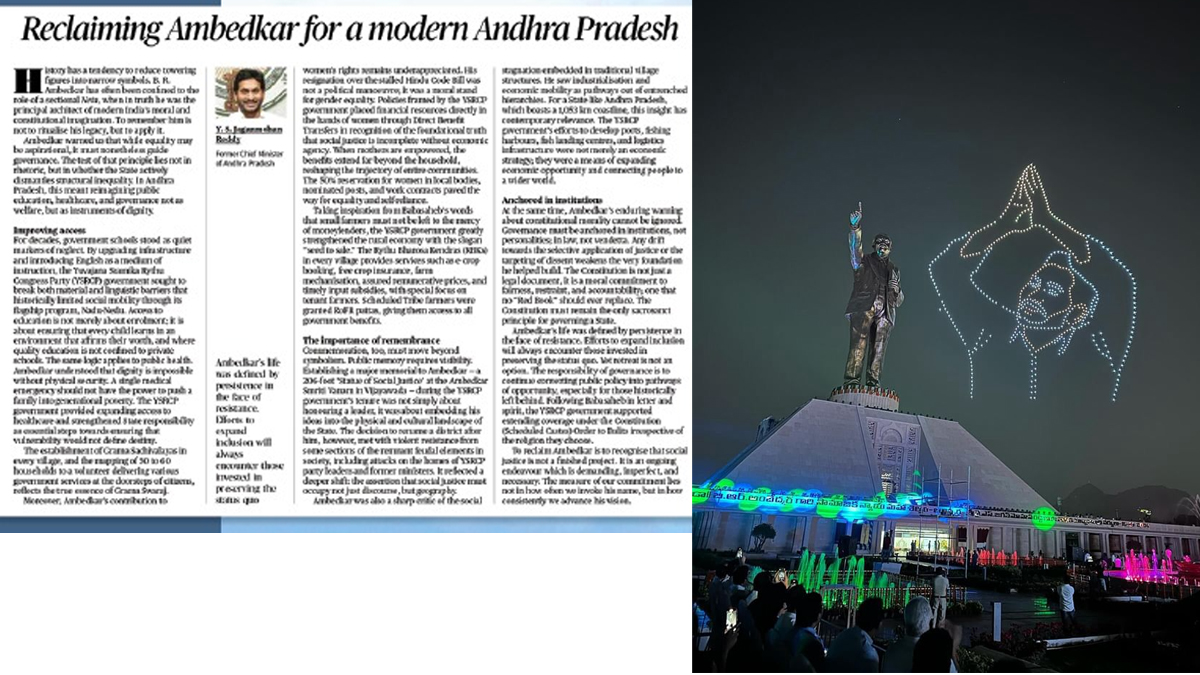
In a powerful and deeply personal opinion piece, former Chief Minister of Andhra Pradesh YS Jagan Mohan Reddy reflects on the life and ideas of Dr. B.R. Ambedkar, presenting them not as historical symbols but as a living blueprint for governance and social justice in modern Andhra Pradesh.
YS Jagan Mohan Reddy argues that history often reduces towering figures like Ambedkar into narrow symbols, confining him largely to the role of a leader of a particular community. In reality, Babasaheb was the principal architect of modern India’s moral and constitutional imagination. The article is both a tribute and a manifesto of YS Jagan’s own lifelong political vision and mission: to reclaim Ambedkar’s ideas and put them into practice through concrete governance.
YS Jagan’s Vision: Equality as the Guiding Star of Governance
At the heart of the article is Ambedkar’s warning that equality, while aspirational, must actively guide every decision of the State. YS Jagan explains that the real test of this principle is not in political rhetoric but in whether the government systematically dismantles structural inequalities. This belief, according to YS Jagan, shaped his entire approach to governance between 2019 and 2024. He reimagined public education, healthcare, and administration not as routine welfare schemes, but as instruments of human dignity, a direct application of Ambedkar’s constitutional morality to the daily lives of ordinary citizens.
Key Initiatives that embodied this Vision
YS Jagan details several flagship programmes that translated Ambedkar’s ideals into action:
- Nadu-Nedu Programme: Government schools, long neglected, were transformed by upgrading infrastructure and introducing English medium instruction. YS Jagan describes this as breaking both material and linguistic barriers that had historically limited social mobility for the poor and backward classes.
- Healthcare Reforms: Recognising that dignity is impossible without physical security, the government expanded access to quality healthcare so that a single medical emergency would no longer push families into generational poverty.
- Grama Sachivalayas: By establishing village secretariats and assigning each volunteer just 50–60 households, services were delivered at the doorstep, a practical realisation of Grama Swaraj.
- Women’s Empowerment: Drawing from Ambedkar’s moral stand on the Hindu Code Bill, YS Jagan’s government introduced Direct Benefit Transfers to place money directly in women’s hands and implemented 50% reservation for women in local bodies, nominated posts, and work contracts.
- Rural Economy (“Seed to Sale”): Rythu Bharosa Kendras (RBKs) were set up in every village to support small and tenant farmers with insurance, mechanisation, assured prices, and input subsidies. Scheduled Tribe farmers received RoFR pattas, ensuring full access to government benefits.
Making Social Justice Visible
YS Jagan emphasises that remembrance must go beyond symbolism. He highlights the installation of the towering 206-foot Statue of Social Justice at Ambedkar Smriti Vanam in Vijayawada and the renaming of a district after Ambedkar, decisions that faced violent resistance from “remnant feudal elements.” For YS Jagan, this backlash itself proved that social justice must now occupy not just discourse, but the very geography of the state.
He also connects Ambedkar’s critique of traditional village structures to Andhra Pradesh’s coastal economy. The development of ports, fishing harbours, and logistics infrastructure was, in YS Jagan’s view, both an economic strategy and a social mission to expand opportunity and break entrenched hierarchies.
Constitutional Morality: The Core of YS Jagan’s Mission
Throughout the article, YS Jagan repeatedly returns to Ambedkar’s warning on constitutional morality. Governance, he stresses, must be anchored in institutions and law, not personalities or vendetta. The Constitution must remain the only sacrosanct principle, a living moral commitment that no other ideology can replace.
YS Jagan concludes by acknowledging that expanding inclusion always meets resistance from those invested in the status quo. Yet retreat is not an option. His mission, he writes, has been to steadily convert public policy into real pathways of opportunity for those historically left behind — including extending Scheduled Caste benefits to Dalits irrespective of religion.
YS Jagan’s Lifelong Mission
For YS Jagan Mohan Reddy, reclaiming Ambedkar is not about ritualistic remembrance. It is an ongoing, demanding endeavour to build a modern Andhra Pradesh where social justice is not a finished project but a continuous journey.