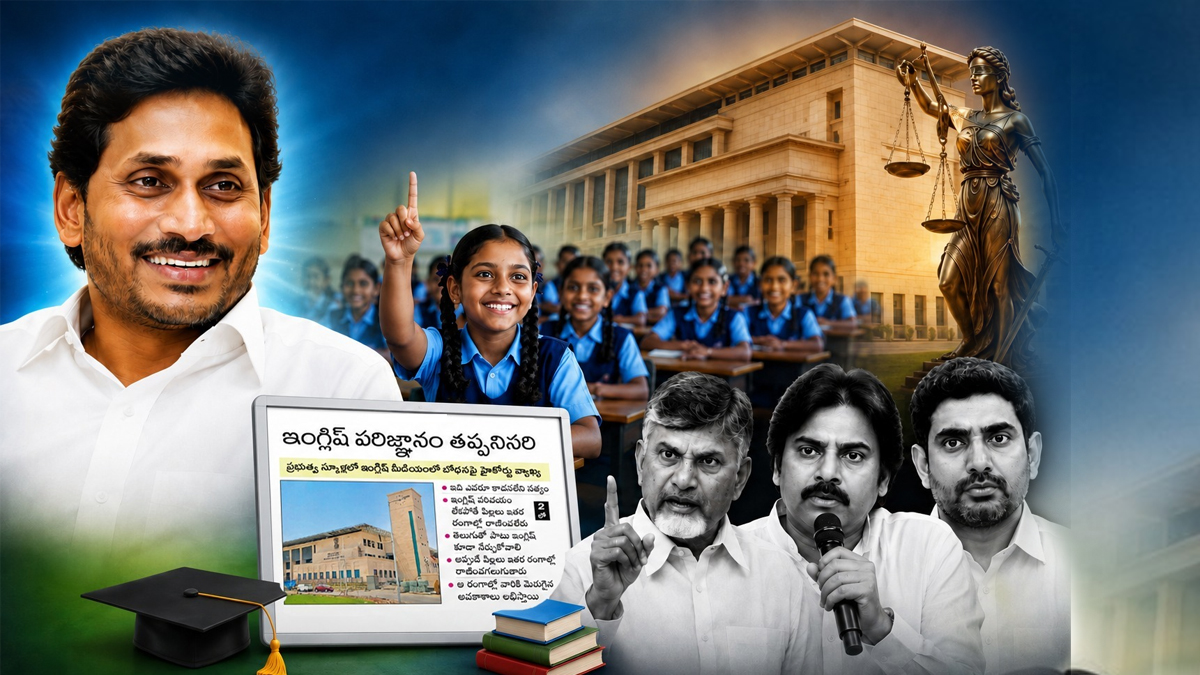
- High Court once again validates Y.S. Jagan’s decision on English medium education
- Court clearly states English proficiency is essential
- Says students will otherwise fall behind in various fields
- Jagan took revolutionary steps for students’ brighter future
- Introduced English medium, bilingual textbooks, digital learning reforms with long-term vision
- Poor students and parents overwhelmingly preferred English medium; 91% of Class 10 students opted for it
- TDP leaders who once opposed English medium are now forced to accept it
- Chandrababu, Pawan Kalyan, Lokesh and others had publicly opposed the reform and even approached courts
- They falsely claimed Telugu language was being destroyed
- Today, Jagan’s reforms stand vindicated as strong and forward-looking policies
The High Court has once again validated the decision taken by the Y.S. Jagan Mohan Reddy government to introduce English medium education in government schools. The court observed that English proficiency is essential in the modern world and stated that students without such knowledge would fall behind in various sectors and opportunities. The judgment has reinforced the view that the reforms introduced during Jagan’s tenure were progressive, practical, and aimed at securing a better future for students from poor and middle-class backgrounds.
During YS Jagan’s tenure, the education sector underwent major transformation through English medium instruction, bilingual textbooks, interactive flat panels, smart TVs, distribution of tabs to Class 8 students and teachers, infrastructure upgrades under the Nadu-Nedu programme, Amma Vodi, fee reimbursement, Vasathi Deevena, Vidya Kanuka, and several other reforms. These initiatives were designed to bring government school education on par with global standards and ensure equal opportunities for poor children. Despite these efforts, the “yellow gang” and opposition parties strongly resisted the reforms and carried out a sustained campaign against English medium education.
The YSRCP government introduced English medium in government schools in 2020–21 while simultaneously making Telugu a compulsory subject. The reform was implemented after obtaining the consent of nearly 93% of parents and students. However, Chandrababu Naidu, Nara Lokesh, Pawan Kalyan, TDP leaders, and several others opposed the move, claiming that Telugu language and mother tongue education were being destroyed. Court cases were filed to obstruct the reform. Yellow media outlets published misleading stories and created panic, while ignoring the aspirations of poor families who wanted quality English education for their children. Critics who educated their own children in elite English medium schools opposed the same opportunity being extended to poor students studying in government schools.
Recent reports have now shown that 91% of Class 10 students prefer English medium education, clearly proving that the opposition to English medium was politically motivated and disconnected from public aspirations. The current situation has made English medium education unavoidable even under the coalition government, exposing the earlier campaign against Jagan’s reforms as deliberate misinformation.
The contradictions of TDP leaders have also become evident. Nara Lokesh himself stated in 2019 that he was not opposed to English medium education. Yet later, TDP and alliance leaders openly campaigned against the policy. Pawan Kalyan even declared in 2023 that his government would file cases against English medium education and related reforms such as TOEFL and IB curriculum in government schools. Chandrababu and others repeatedly accused the YSRCP government of undermining Telugu language and culture.
At the same time, almost all prominent TDP and Jana Sena leaders educated their own children and grandchildren in English medium schools, many of them in elite institutions in Hyderabad, Bengaluru, Delhi, Singapore, and the United States. The list includes Nara Lokesh, Ashok Gajapathi Raju, Ram Mohan Naidu, Somireddy Chandramohan Reddy, Ganta Srinivasa Rao, Ayyanna Patrudu, Narayana, Nadendla Manohar, Pawan Kalyan, and several others whose children studied in English medium institutions in India and abroad. This exposed the hypocrisy of opposing English medium education only for poor children studying in government schools.
Before 2019, government schools in Andhra Pradesh largely offered only Telugu medium education. Due to the absence of English medium options, lakhs of parents shifted their children to private schools despite severe financial burden. Surveys conducted by the Jagan government revealed that 95% of parents wanted English medium education for their children. The lack of English medium in government schools had also contributed to the closure of nearly 1,785 government schools in different phases. Respecting the aspirations of parents and students, the YSRCP government implemented English medium education in phases starting from Classes 1 to 6 in 2020–21, then extending to Class 7 in 2021–22, Class 8 in 2022–23, and Class 9 in 2023–24.
The contrast with the previous TDP government was significant. Between 2014 and 2019, Chandrababu Naidu allegedly weakened government schools through rationalisation policies, leading to the closure of around 6,000 schools. Basic facilities such as toilets, drinking water, books, and timely midday meal payments were neglected. Expenditure on improving government schools reportedly remained below Rs. 50 crore annually. The criticism is that the previous government indirectly pushed students towards private institutions such as Narayana and Chaitanya schools instead of strengthening public education.
In contrast, the YSRCP government pursued a “Right to English Medium” approach. Through the Nadu-Nedu programme, steps were taken to improve 44,000 schools by providing nine categories of infrastructure including drinking water, compound walls, lighting, fans, and classroom improvements. Measures were also initiated to upgrade one high school in every mandal into a junior college. Combined with reforms such as Amma Vodi and English medium instruction, the government aimed to bring international standards into public education.
Today, the growing preference for English medium education among students and parents, along with the High Court’s observations on the importance of English proficiency, has once again reinforced the validity of Jagan’s educational reforms. The developments demonstrate that despite political opposition and misinformation campaigns, the reforms reflected the genuine aspirations of the people and were designed to empower poor children to compete at national and global levels.