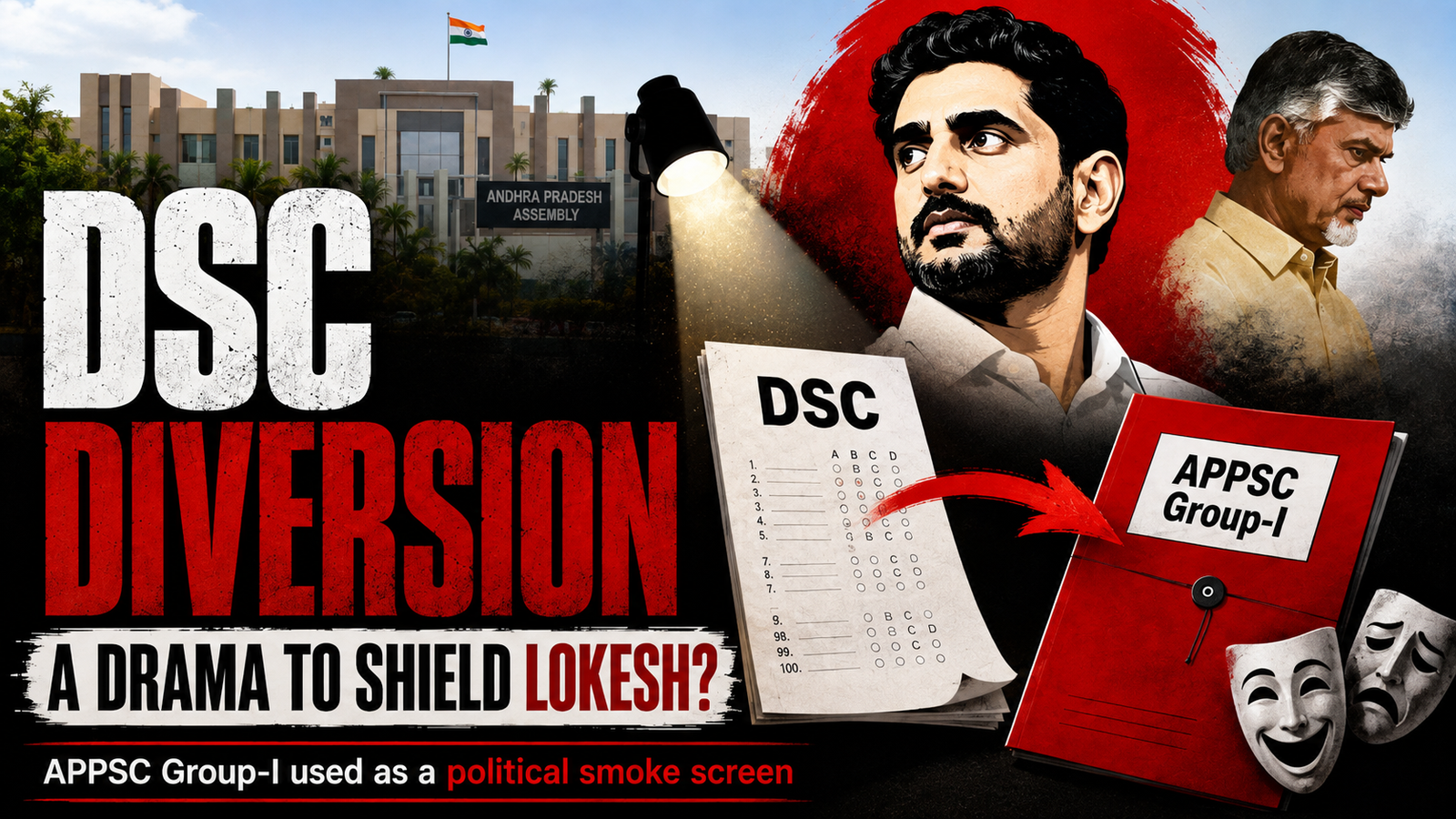
The Chandrababu Naidu government, caught in the middle of serious allegations involving leakages, irregularities, sale of jobs and deal-making in the DSC examinations, has now launched a massive diversionary exercise to shield Minister Nara Lokesh from the controversy.
An APPSC Group-I notification issued nearly eight years ago has been dug up and the SIT report is now being turned into a political weapon to create the impression that something extraordinarily grave had happened during the YSRCP government.
Fearing that the YSRCP would strongly expose the alleged DSC irregularities during the Assembly session, the government hurriedly brought the SIT report into the public domain, convened a meeting with ministers and subsequently unleashed a campaign against YSRCP through the pro-TDP media.
Even though the factual findings contained in the SIT report itself contradict much of the government’s political narrative, those facts are being suppressed. Selective observations are instead being picked out and used to malign the YSRCP.
Dug Up a Mountain, Yet Couldn’t Even Find the Tail of a Mouse!
Nowhere does the SIT report establish that there were irregularities in the eligibility, competence, merit, ranks or selection of the candidates.
There is no evidence to show that the answer scripts were tampered with. Nor has it been established that additional marks were illegally awarded to selected candidates or that ineligible persons were brought into government service.
The report makes it clear that the candidates had no individual involvement in any alleged wrongdoing and that they were selected on the basis of merit.
In other words, after digging up an entire mountain, the SIT has not even been able to find the proverbial tail of a mouse.
Despite this, the Chandrababu government is attempting to seize upon unrelated or questionable observations in the SIT report to cast a shadow over the entire selection process.
The motive behind this exercise is evidently not a bona fide attempt to establish the truth. Rather, the political objective appears to be to protect Nara Lokesh and divert attention away from the alleged irregularities in the DSC recruitment process.
None of the Irregularities Alleged in DSC Took Place in APPSC
In the DSC recruitment process, the Chandrababu government issued special GOs favouring certain individuals. There have also been allegations that exemptions from examinations were granted to some candidates. Audio and video material relating to alleged paper leaks, outsourced employees securing top ranks, sale of Sports Quota posts, bargaining, and financial transactions has surfaced.
But none of these circumstances existed in the APPSC Group-I selections. There were no special GOs. There were no exemptions from examinations. There was no paper leak. There are no audio or video records showing that jobs were sold. Nor did outsourced employees suspiciously secure first ranks.
When the government has failed to answer these serious allegations concerning the DSC recruitment, what else can the attempt to manufacture stories around APPSC be called other than a deliberate diversion?
Political Colour Through a Second SIT!
Within the first year after the coalition government came to power, a complaint was lodged at Suryaraopet in Vijayawada on April 22, 2025, following which an SIT was constituted.
What did that SIT investigate? What did it conclude? What happened to its report? Even today, there is no clarity.
At the same time, however, the State Government argued before the High Court that the selection process had been conducted properly.
Later, pursuant to the directions of the High Court, another SIT was constituted on February 14, 2026. It was only after the constitution of this second SIT that the tone of the government’s arguments began to change.
A process that the government had until then maintained was conducted properly suddenly began to be portrayed through the prism of political allegations.
When the controversy surrounding the DSC recruitment reached its peak, the same SIT report was hurriedly brought into the public domain. The political purpose behind the timing is not difficult for the people to understand.
Every Step Was Under the High Court’s Supervision
From the issuance of the Group-I notification to the eventual appointment of candidates, every stage of the process proceeded in accordance with the directions of the High Court.
The answer scripts of all 325 candidates who appeared for the interviews, the candidates who were ultimately selected for appointment, and those who approached the courts were all under judicial custody.
The SIT confirmed that there were no alterations, additions or tampering in the answer scripts. Forensic examination also established that the original answer scripts remained intact and unaltered.
Even after these findings, attempts are being made to cast aspersions on candidates, level false allegations against them, and place the careers and futures of serving Group-I officers at risk.
Are these not manifestations of political vendetta and diversionary politics?
Manual Evaluation Alone Formed the Basis of Selection
Digital valuation was not considered for the final selection of candidates. The process conducted at Haailand was also not taken into account for appointments.
Candidates were selected solely on the basis of the marks secured in the manual evaluation conducted pursuant to the directions of the High Court.
The High Court did not hold that digital valuation was inherently wrong. It observed that, as part of ensuring transparency, examination systems must evolve in accordance with technological advancements.
However, since the original notification had not informed candidates in advance that digital evaluation would be adopted, the Court directed that a manual valuation be conducted.
Accordingly, the answer scripts were evaluated again through the manual process and appointments were made on the basis of those marks.
Despite the fact that the digital valuation process set aside by the High Court was not used for the final selection, the government is now seeking to resurrect the very same issue as a fresh controversy.
What else can this be called other than a political deception?
Lies About Haailand Exposed
For years, the TDP and pro-TDP media have repeatedly claimed that answer scripts were evaluated at Haailand by unqualified persons and data-entry operators. However, the Chandrababu government itself stated in an affidavit submitted to the High Court in 2025 that no manual valuation took place at Haailand. The SIT has now confirmed the same.
What took place at Haailand was only the “bubbling–tabulation” process of entering, on OMR sheets, the marks obtained after digital valuation. It was not a second evaluation.
The SIT stated that not even one of the 452 subject experts empanelled for evaluation participated in the Haailand process, because no actual evaluation of answer scripts took place there.
Although the answer scripts remained at Haailand for 84 days, forensic examination found that there was no tampering, alteration or manipulation of the scripts.
Moreover, the entire Haailand process was subsequently set aside. Pursuant to the High Court’s directions, the answer scripts were again subjected to manual evaluation, and appointments were made solely on the basis of the marks awarded in that process.
Despite all this, repeatedly recycling the same allegation in the name of Haailand is nothing but an attempt by the pro-TDP media to mislead the public.
Pro-TDP Media’s False Narrative on OMR Corrections
Using the mere fact that certain corrections were visible on OMR sheets to discredit the entire selection process reflects a lack of understanding of the evaluation procedure.
The evaluation of answer scripts involves several levels of scrutiny, including the Camp Officer, Assistant Camp Officer, Examiner, Scrutiniser and Chief Examiner. Every answer script passes through multiple stages of verification.
Where errors are identified, they are corrected, recorded in the control bundle slip, and authenticated by the signatures of the concerned officials.
The process also involves rechecking whether every question has been examined, whether marks have been awarded for each question, and whether those marks have been correctly entered on the OMR sheet.
Where necessary, the paper may be sent back to the first evaluator for re-examination or referred to another evaluator.
The Chief Examiner also has the authority to review and moderate marks in order to maintain uniformity in evaluation. UPSC guidelines likewise require the Chief Examiner to personally evaluate a certain number of papers every day.
This moderation procedure was not unique to the 2018 Group-I examination. It was also followed in APPSC examinations relating to 2016, 2017, 2022 and 2023.
Corrections Were Made by Examiners, Not Outsiders
Pro-TDP newspapers alleged that unidentified persons had made corrections on OMR sheets and that such persons were not qualified to do so.
However, the SIT report states that the corrections were made by the examiners themselves.
It further records that, during the inquiry, some examiners stated that they had inadvertently failed to sign at certain places after completing the evaluation.
The SIT also clarified that the absence of signatures did not mean that outsiders had any opportunity to alter the marks.
Even though the SIT report itself has exposed this allegation as false, the pro-TDP media continues to repeat the same malicious narrative.
Living Proof of Merit
A look at the educational qualifications and professional backgrounds of the 325 candidates who appeared for the interviews makes the calibre of the candidates abundantly clear.
Among them were 19 candidates from IITs, seven from IIMs, 17 from NITs, two from BITS Pilani and 13 from IIITs. As many as 177 candidates had completed engineering or medicine, while 39 were general postgraduates or graduates. In addition, 34 candidates had worked in Central Government institutions, 103 in the State Government or its affiliated institutions, and 101 were employed in other sectors. The group included IT professionals, bankers and doctors.
As many as 39 candidates had qualified for Civil Services interviews. Even after securing Group-I posts, 16 candidates went on to be selected for the IAS, IPS, IFS, IRS and other Central Services.
Two candidates who were allotted cadres in other States chose to relinquish their Civil Services posts and continue serving in Andhra Pradesh because they wanted to work in their home State.
Some candidates selected through this very Group-I notification later appeared for another APPSC examination, succeeded again and were selected as Deputy Collectors.
What stronger evidence could there be of both the merit of these candidates and the credibility of the examination process?
Then How Was One of These Officers Appointed as Kuppam RDO?
The Chandrababu government itself appointed an officer selected through this very recruitment process as the Kuppam Revenue Divisional Officer (RDO).
Even though the Court had directed that the selected officers be posted only in non-focal positions, the same officer was also entrusted with responsibilities in the Kuppam Urban Development Authority.
When the government needs the services of an officer selected through this process, that officer is considered competent. But when there is a political need to target the YSRCP, suddenly the entire selection process is branded as flawed.
Should institutions function on the principle that whatever Chandrababu declares “right” is right, and whatever he calls “wrong” automatically becomes wrong?
What kind of politics is this?
Robust Randomisation in the Interview Process
As many as 24 senior IAS and IPS officers served as members of the interview boards in this selection process. Six Vice-Chancellors from different universities in the State also participated in the interviews.
Before the YSRCP came to power, there used to be only one interview board, with just one Civil Services officer serving on it.
The YSRCP government introduced reforms and constituted three separate interview boards. Each board had three members, and across different stages, a total of 24 senior officers conducted the interviews.
Two of the board chairpersons, K. Vijay Kumar and Professor Padmaraju, had themselves been appointed during the previous Chandrababu government.
While APPSC Chairman Gautam Sawang interviewed 104 candidates, K. Vijay Kumar, who had been appointed during Chandrababu Naidu’s tenure, interviewed 102 candidates.
A randomised “jumbling” system was followed so that candidates would not know in advance which board would interview them.
In such a tightly structured and randomised system, can the allegation that a single individual manipulated or influenced the entire selection process withstand scrutiny?
What makes the situation even more striking is that Ravi Shankar Ayyanar, a DG-rank officer who was a member of the second SIT, himself later served as a member of an interview board for a subsequent APPSC notification and interviewed candidates.
YSRCP Reforms Strengthened Transparency
It was the YSRCP government that introduced far-reaching reforms in APPSC recruitment to strengthen transparency and integrity in the examination process.
Continuous CCTV surveillance was introduced at evaluation centres. Facial recognition and fingerprint capture were brought in to prevent impersonation and duplicate candidates. CCTV cameras were also installed in every examination hall.
After such stringent and technology-driven safeguards were implemented in Andhra Pradesh, similar technological measures began to be adopted in UPSC examinations as well.
Instead of appreciating these reforms, attempts are now being made to discredit the very system for political purposes. This reflects the Chandrababu government’s politics of vendetta rather than any genuine concern for institutional reform.
Chandrababu Government Itself Is at the Root of the Controversy
The very Group-I notification at the centre of the present controversy was issued by the Chandrababu government on December 31, 2018.
The preliminary examination was conducted before the 2019 elections. Candidates later approached the High Court alleging that 62 questions in the preliminary examination were incorrect. The matter eventually reached the Supreme Court.
The then government and the then APPSC Chairman, Uday Bhaskar, were unable to satisfactorily address the issues raised over those questions. That case continues to remain pending before the Supreme Court.
Having failed to answer questions arising from a notification issued during its own tenure, the Chandrababu government is now preaching about a selection process that was completed during the YSRCP government under the supervision and directions of the High Court. This is nothing but political bankruptcy.
78 Notifications, 6,296 Jobs: No Controversy
During the YSRCP government, 78 notifications were issued through APPSC and 6,296 posts were filled.
There were no comparable controversies surrounding those recruitment exercises.
Technology was integrated at every stage, from the conduct of examinations to evaluation, in order to enhance transparency and strengthen the credibility of the recruitment process.
Against such a record, the attempt to revive an old Group-I case and place it at the centre of political controversy is clearly aimed at obscuring the allegations the Chandrababu government is currently facing over the DSC recruitment process.
The effort to tarnish APPSC’s record and shift public attention away from the DSC issue is unmistakably a political diversion.
A Political Sword Hanging Over the Lives of Meritorious Officers
- For purely political purposes, the government is not only discrediting a rigorously conducted selection process but also unsettling the lives and careers of officers who have been serving the public in senior positions for the past four years.
- According to the SIT report, the candidates were not at fault and there was no deficiency in their merit.
- There was no tampering of the answer scripts.
- No evaluation took place at Haailand.
- The digital valuation marks were not considered for final selection.
- The manual evaluation was conducted pursuant to the directions of the High Court.
- Despite all these facts being on record, creating suspicion around the selected officers amounts to an attack on their dignity and self-respect.
- Is it fair for the Chandrababu government to subject the families of meritorious officers to severe mental distress merely for the sake of political diversion?
This ‘Diversion Drama’ Is Only to Protect Lokesh!
Unable to answer the serious allegations surrounding the DSC recruitment process, the government is now creating a storm of falsehoods around APPSC.
- What is the government’s answer to the allegations of a DSC paper leak?
- How did outsourced employees secure top ranks?
- Where is the inquiry into the allegations concerning the sale of Sports Quota posts?
- What action has been taken on the audio and video material that surfaced?
- Who was given control over the centralised recruitment process?
The truth will not change merely because an old case is repackaged with a new political narrative in an attempt to divert public attention from these questions.
Facts in the SIT Report Tear Apart Chandrababu’s Propaganda
The facts contained in the SIT report itself demolish the Chandrababu government’s propaganda surrounding the APPSC Group-I examinations.
It is becoming increasingly clear that the narrative suggesting that something improper had occurred during the YSRCP government is being pushed primarily as an attempt to escape scrutiny over the alleged DSC scam.
The conspiracy, according to YSRCP, stems from the government’s fear that the alleged DSC irregularities will be strongly raised during the Assembly session, along with demands for Nara Lokesh’s resignation and a CBI inquiry into the DSC recruitment irregularities.
It is in this context that the pro-TDP media ecosystem is being accused of manufacturing and amplifying false narratives.
This, YSRCP argues, is a grotesque political exercise in which the future of 163 serving officers is being placed at risk merely to protect the political future of Nara Lokesh.
YSRCP is therefore intensifying its campaign to place the facts before the people, counter what it describes as false propaganda, expose the political motives behind the controversy, and alert the public to what it calls an attempt to sacrifice the careers of meritorious officers for partisan political ends.