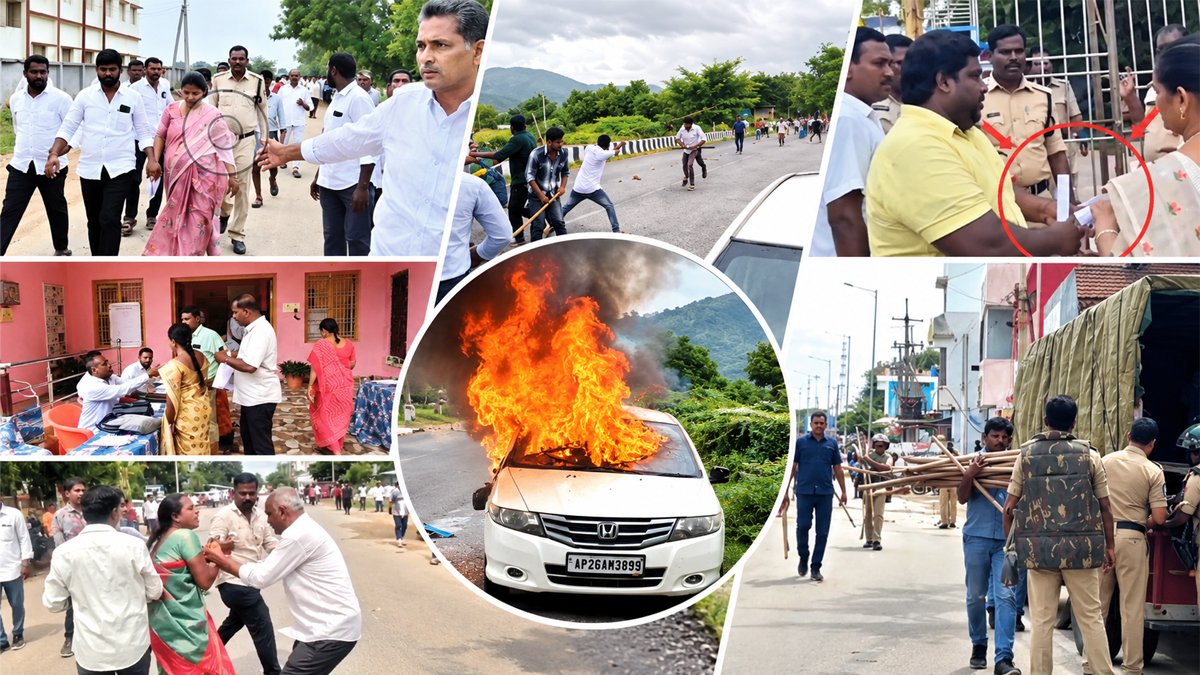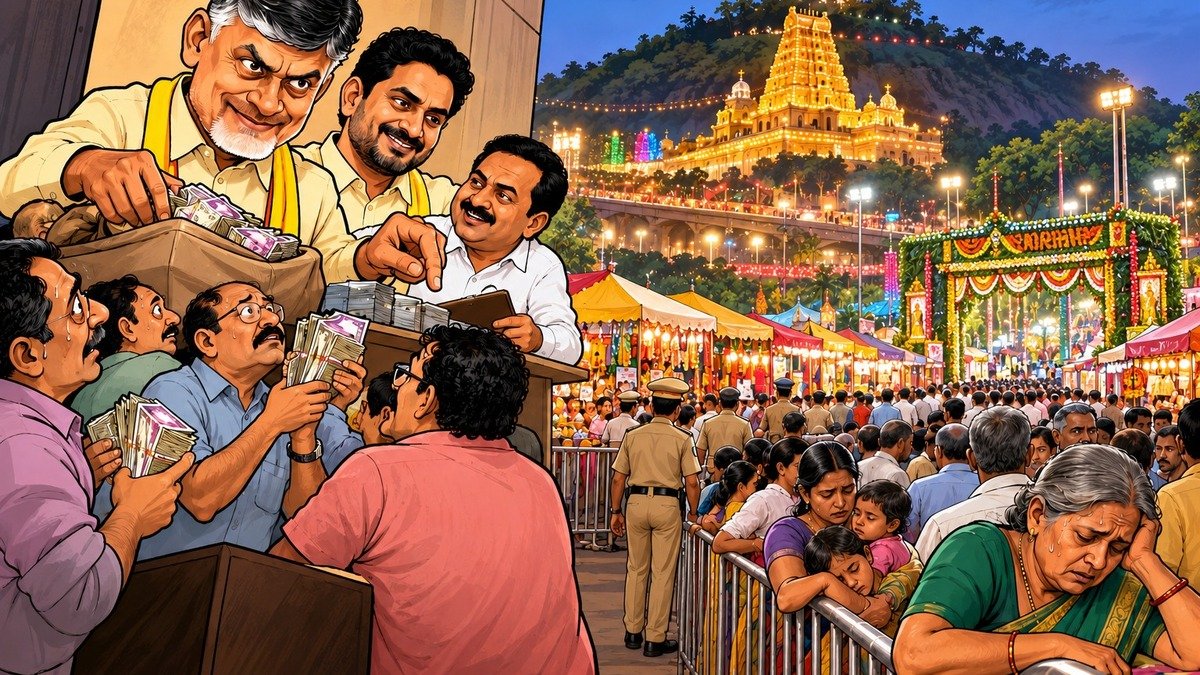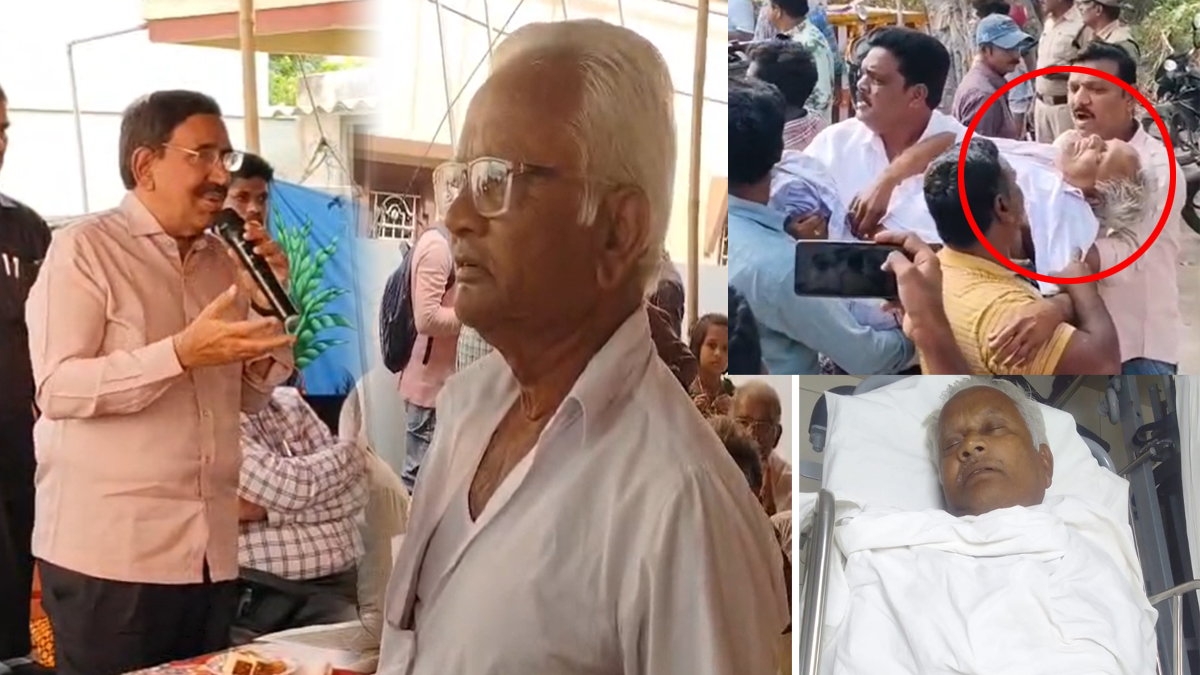
The crisis in Amaravati has reached a tragic and dangerous point. The uncertainty created by Chandrababu Naidu in the name of the capital has not only paralysed development but has pushed farmers into unbearable distress. On Tuesday, a heart-wrenching incident exposed this reality when a capital-region farmer collapsed and died after voicing his anguish in front of Minister Narayana. His final words reflected the pain, betrayal and helplessness felt by thousands of farmers who surrendered their fertile lands believing the promises of the government. This tragic death stands as a symbol of how deeply farmers have been trapped in a vortex of uncertainty created by Chandrababu Naidu’s policies.
Ignored cries, unanswered pleas
Ramarao, a farmer from Mandadam village, trusted Chandrababu Naidu and gave away 2 acres out of his 5 acres under the land pooling scheme. In return, he was allotted “returnable plots”, shockingly located inside a stream. For years, he kept approaching officials asking how land taken from him could be replaced with unusable plots.
For the past 18 months alone, he has been repeatedly visiting government offices, pleading for justice. No official listened. No solution was offered. Instead, he was pushed from desk to desk. Now, attempts are allegedly being made to even take his house. Ramarao’s case is not an exception, it mirrors the fate of hundreds of farmers across the capital region.
From betrayal to betrayal
From betraying N.T. Rama Rao in the past betraying today’s capital farmers, Chandrababu Naidu’s political history, critics say, is marked by repeated backstabbing. During the first phase of Amaravati, nearly 54,000 acres were pooled, of which 34,000 acres came directly from farmers. Even today, the government has failed to complete the process of handing over returnable plots. Nearly a decade has passed since farmers surrendered their land. Yet, thousands still do not know where their allotted plots are located or what their boundaries are. Registrations for nearly 8,500 returnable plots remain pending. If Amaravati is truly his priority, why have these basic obligations not been fulfilled?
‘Amaravati is my priority’: only in speeches?
Chandrababu Naidu repeatedly claims Amaravati as his top priority. But on the ground, even the most basic issues of farmers remain unresolved. If he conceptualised the capital, why has he failed to ensure justice to those who sacrificed their land?
The reality, critics argue, is that his focus is not on farmers but on commissions and collections. Instead of first completing development and handing over plots to rightful owners, the government is now preparing to acquire another 16,666 acres. Along with government land, this comes close to 20,000 acres more.
When unresolved problems plague the first phase itself, acquiring more land only deepens the crisis. It raises a serious question: is this governance or a repeat of the same deception under a new episode?
Farmers say they are treated with contempt
Farmers allege that whenever they approach officials or visit the CRDA office, they are treated with indifference and humiliation. Ministers and officials, they say, refuse even to acknowledge them. Many now claim they are seeing Chandrababu Naidu’s “real face” for the first time. According to them, the renewed push for land acquisition is nothing but an attempt to extend the “Amaravati serial”, adding new chapters of promises while old commitments remain unfulfilled. There appears to be little intention either to deliver justice to farmers or to complete essential capital works.
Contractor syndicates and inflated estimates
Before 2019, tenders worth Rs. 41,170 crore were finalised for Amaravati works. Even then, the rates were unusually high and companies functioned as a syndicate. Out of this, only Rs. 5,587 crore worth of work was actually executed, leaving unfinished projects worth Rs. 35,583 crore. Now, the same works are being projected at a staggering Rs. 77,000 crore. Chandrababu Naidu himself conveyed this figure to the 16th Finance Commission. In just five to six years, project estimates have almost doubled, a phenomenon rarely seen anywhere in the world. This sharp escalation raises serious questions. Critics allege that inflating estimates has become a mechanism to extract commissions, while farmers’ issues remain deliberately ignored.
System redesigned for commissions
The Secretariat requires about 1,250 regular staff, and including IAS officers, around 1,400 personnel. Yet, the government proposes infrastructure spending running into crores per employee. Even the offices of the US President, the Saudi monarch, or the Sultan of Brunei do not spend at such levels. Why this extravagance? The answer, critics say, lies in commissions. Soon after coming to power, Chandrababu Naidu scrapped judicial preview and reverse tendering systems, mechanisms earlier introduced to ensure transparency in contracts. Their removal, critics allege, opened the doors for contractors–government collusion and large-scale public fund siphoning.
Hundreds of crores wasted on ‘temporary’ buildings
Under the pretext of temporary arrangements, hundreds of crores have already been spent. At Velagapudi, six so-called temporary buildings were constructed at costs exceeding Rs. 11,000 per square foot, covering nearly six lakh square feet.
These structures are now being discarded, with fresh constructions being proposed. Income Tax cases have already revealed allegations of massive commissions in these projects. The government even borrowed an additional Rs. 353 crore to construct temporary Secretariat and High Court buildings.
Such spending on temporary infrastructure is unheard of anywhere in the world. Yet, the same government now proposes spending around Rs. 1,650 crore for permanent Assembly and High Court buildings, while farmers still await their rightful plots.
Bigger than Parliament, bigger than the Supreme Court?
Is it necessary to build a High Court larger than the Supreme Court or an Assembly bigger than Parliament? India’s new Parliament building cost around Rs. 970 crore, while the Andhra Pradesh Assembly alone is estimated at Rs. 724 crore for just 175 MLAs.
Highway projects in Amaravati are being sanctioned at shocking rates — up to Rs. 53.88 crore per kilometre, and in some cases over Rs. 60 crore. One road alone is estimated at Rs. 179 crore. For such projects, there is urgency and attention. For farmers, there is none.
Is this the “vision” being sold to the people?
Chandrababu Naidu continues to speak of a grand vision and promises wonders. But while his words soar high, ground reality tells a different story. What continues to rise steadily is corruption, inflated costs and public debt.
Amaravati today stands as a symbol of that contradiction — grand speeches on one side, and broken farmers on the other. The so-called capital vision has become a story of deception, commissions and betrayal, while those who sacrificed their land continue to wait for justice.