- Public money is being handed over to party workers while the government promotes it as a “Palle Panduga”.
- Villages are in distress because of the Coalition Government’s failures.
- No effective drought-management plan and no declaration of drought-hit mandals.
- Farmlands are without irrigation water, while people struggle even for drinking water.
- Rythu Bharosa Kendras have been weakened.
- The Village and Ward Secretariat system created for administrative decentralisation has been crippled.
- The volunteer system that delivered government services at people’s doorsteps has been abolished.
- Government schools are deteriorating and Nadu-Nedu works have been left incomplete.
- Village Health Clinics are being neglected.
- Coalition leaders are inaugurating routine cement roads and presenting them as a “Palle Panduga”.
The Chandrababu Naidu-led Coalition Government is conducting a massive publicity campaign in the name of “Palle Panduga”, while public money worth crores of rupees is being channelled to party workers. Government failures, the impact of El Niño and the lack of foresight in tackling drought have together pushed rural Andhra Pradesh into distress. Even amid this crisis, Chandrababu Naidu and Pawan Kalyan are turning routine works such as filling potholes under MGNREGS and clearing vegetation along roadsides into publicity events and branding them as major achievements.
Fake documents for Rs. 1 Crore works
A serious corruption episode recently surfaced in a department headed by Pawan Kalyan. In Rolla mandal of Madakasira constituency, MPDO Srinivasa Rao created fake documents for works worth nearly Rs. 1 crore by forging the signature of YSRCP MPP Suma, even though the works had not been executed, and attempted to draw the money.
The question is how many such cases remain hidden across the State and how much government money is being diverted to party workers. During Chandrababu Naidu’s previous tenure too, contracts worth crores under the Neeru-Chettu programme were handed over through Janmabhoomi Committees, resulting in large-scale misuse of public funds.
A real village festival should mean prosperity in farmers’ homes, employment for agricultural labourers, proper facilities in village schools, medicines in health centres, safe drinking water for every household and government services available without forcing people to run from office to office. Only when these basic needs are met can there be a true festival in rural life.
Instead, systems created during the Y.S. Jagan Mohan Reddy government, including Village Secretariats, volunteers, RBKs, Village Health Clinics and strengthened government schools, are being dismantled. At a time when villages are facing drought and shortages of drinking and irrigation water, Chandrababu Naidu and Pawan Kalyan are staging publicity events in the name of “Palle Panduga”.
Where is the Drought preparedness?
The World Meteorological Organization had warned as early as June about the possible impact of El Niño on rainfall and temperatures and urged governments to use early forecasts to protect livelihoods.
Managing available water reserves, supporting alternative crops, preparing fodder stocks and protecting drinking-water sources are fundamental government responsibilities. But conditions on the ground are entirely different.
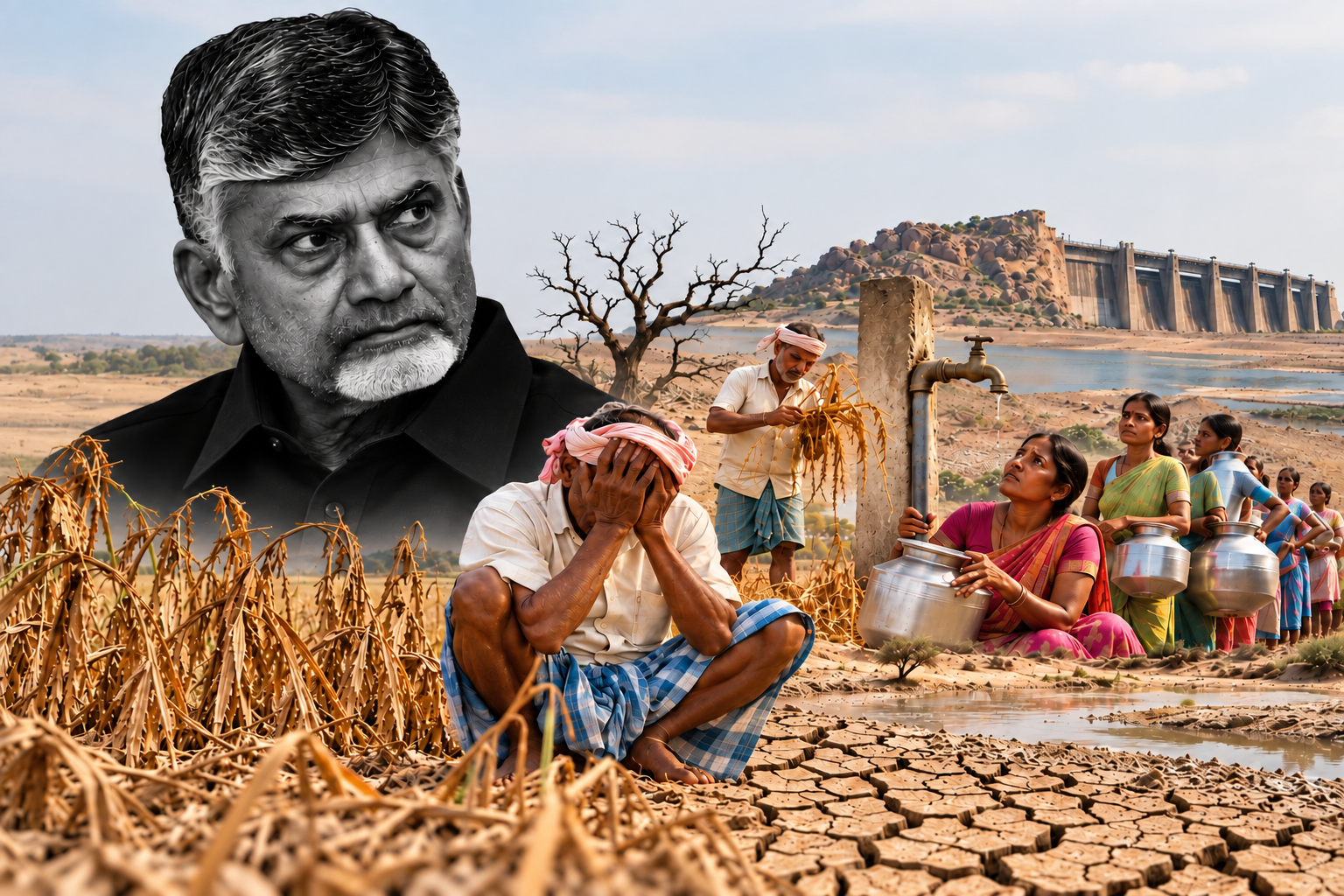
People have taken to the streets in Visakhapatnam demanding drinking water. Groundwater levels have fallen sharply, not only in Rayalaseema but in several other regions. Farmers in the Krishna Delta and elsewhere are watching standing crops wither because of inadequate irrigation.
The government has still not declared drought-hit mandals. According to officials themselves during a government review, drought-like conditions exist in 513 mandals, of which 268 are facing severe conditions and 245 moderate conditions. Yet the government continues to delay the declaration of drought-affected mandals.
RBKs rendered ineffective
The Y.S. Jagan government established 10,778 Rythu Bharosa Kendras to support farmers from sowing to procurement and ensure remunerative prices for their produce.
Seeds, fertilisers and pesticides were supplied at subsidised prices and on time. Crop procurement was conducted through RBKs, while scientists and agricultural experts provided technical guidance to farmers.
Today, these systems have weakened. Farmers are forced to wait for days outside fertiliser shops, while agricultural inputs are being diverted into the black market. Procurement through RBKs has virtually disappeared, and expert advisory services are no longer functioning as before.
By merely renaming RBKs as Rythu Seva Kendras, the Chandrababu government has weakened a system that had become the backbone of farmer support.
Announcements, but where is Relief for Farmers?
The government and the Chief Minister are asking farmers to take up horticulture crops. Chandrababu Naidu stated during a review that Rs. 190 crore had been allocated for the protection of horticulture crops.
At the same meeting, officials said crops under 1,357 Rythu Seva Kendras across 21 districts faced high risk.
When even the limited crops already cultivated by farmers are drying up because of lack of water, the government is advising them to expand horticulture instead of first protecting existing crops.
Farmers say that if the situation continues, survival itself will become difficult. In 2025, 393 farmers and 2,472 agricultural labourers died by suicide.
Decentralisation dismantled, Centralisation restored
Inspired by Mahatma Gandhi’s vision of Gram Swaraj, the Y.S. Jagan government took major steps towards administrative decentralisation between 2019 and 2024.
Village and Ward Secretariats were established to provide quality government services locally. Local youth received employment opportunities through these institutions. The volunteer system delivered welfare schemes and public services directly to people’s homes.
During the COVID-19 pandemic, volunteers played an important role in fever surveys, identification of patients, medicine distribution and other emergency services.
Before the elections, Chandrababu Naidu and Pawan Kalyan promised volunteers a salary of Rs. 10,000. After coming to power, however, the system itself was abolished.
The government is now reducing Secretariat staff and services in the name of rationalisation and moving towards a more centralised system. Secretariat employees are being burdened with excessive duties, and those who raised their voice in protest were subjected to police action.
Government Schools being weakened
The YS Jagan government invested heavily in improving government schools attended by poor and middle-class children. Under Mana Badi Nadu-Nedu, Rs. 8,524 crore was spent to develop 15,713 schools. Works taken up in another 22,312 schools were subsequently stopped after the change of government.
English-medium education, CBSE and IB initiatives have been stalled. Programmes such as TOEFL training, distribution of tablets to Class VIII students and bilingual textbooks have also been discontinued.
Student enrolment in government schools has fallen from 40,50,031 to 34,61,612 during the last 27 months. Nearly 4.64 lakh students dropped out in two years, while another one lakh students have already moved away from government schools during 2026-27.
In the name of teacher rationalisation, the government is destabilising schools and is moving towards shutting down 32,595 schools with fewer than 60 students.
Rural Healthcare in Crisis
The Coalition Government’s neglect of public health is severely affecting rural healthcare.
The YS Jagan government initiated the establishment of 17 government medical colleges, but the present government is attempting to bring them under PPP arrangements. Aarogyasri is being moved towards an insurance-based model, while public healthcare services are being weakened.
During the previous government, 104 Mobile Medical Units regularly visited villages with PHC doctors. Today, many of these vehicles remain idle.
The 10,132 Village Health Clinics, established at the rate of one clinic for every 2,500 people, are being weakened. Works on tribal multi-speciality hospitals taken up with Rs. 246 crore have slowed or stopped.
Government hospitals are also facing shortages of medicines, syringes and surgical supplies. During the Jagan government, 562 medicines meeting WHO and GMP standards were made available.
The Family Doctor system, under which every mandal had two PHCs, each PHC had two doctors, and two 104 vehicles delivered healthcare to people’s doorsteps, has also been sidelined.
Under Nadu-Nedu, Rs. 3,820 crore was spent on developing 11 teaching hospitals and another Rs. 1,223 crore on Area Hospitals, CHCs and PHCs. Remaining works have now been halted. Specialists have been removed from the Palasa Kidney Research Centre, while construction of the Markapuram Kidney Centre has stopped.
By weakening institutions that had brought services directly into villages, failing to address drought and water shortages, and leaving rural families in distress, the government is now celebrating the inauguration of a few cement roads as “Palle Panduga”, while the real problems of rural Andhra Pradesh remain unresolved.