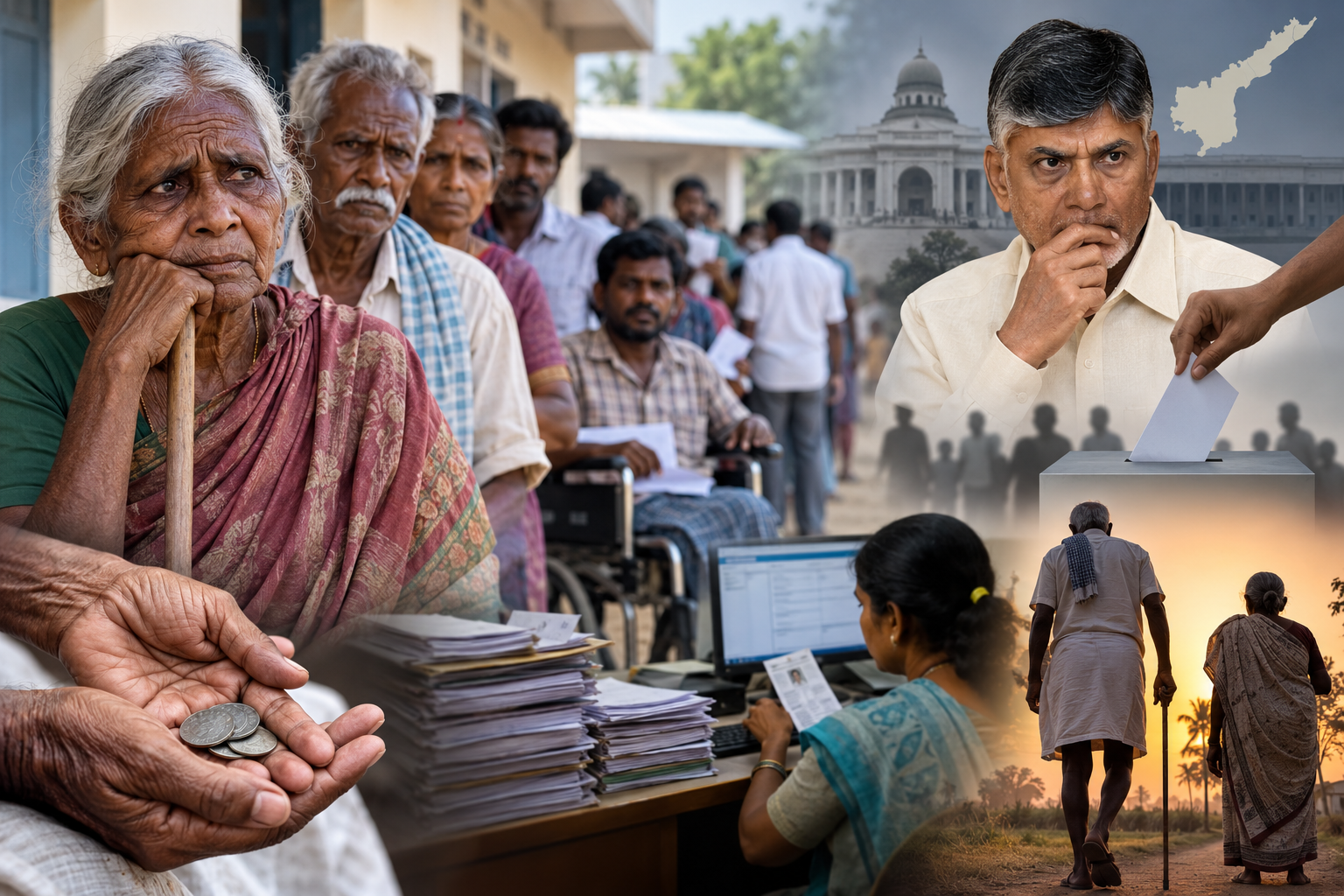
For more than two years, thousands of elderly people, widows, persons with disabilities, single women and chronically ill beneficiaries in Andhra Pradesh were denied even the opportunity to apply for a new pension. Now, with local body elections drawing closer, the Chandrababu Naidu government has suddenly reopened applications, but only for seven working days.
The move has triggered a fresh political controversy. The government has neither guaranteed that every eligible applicant will receive a pension nor announced when payments will begin. Instead, sanction has been linked to availability of funds and budget releases. It has also made clear that pensions will not be paid retrospectively from the date of application or eligibility.
The question therefore is simple: after keeping the application system shut for more than two years, is the government genuinely trying to expand social security, or is this merely a poll-time exercise?
Eligible, but kept waiting
During the last two years, senior citizens who crossed 60, widows who lost their husbands, eligible persons with disabilities and other vulnerable sections had no regular window to seek a new pension. The online application portal remained closed, and people who approached village and ward secretariats were unable to file fresh applications.
Now the government has directed secretariats to receive applications, complete online registration and e-KYC up to the 16th. But after holidays are excluded, beneficiaries effectively have only seven working days.
That creates an immediate practical problem. How are lakhs of applications accumulated over more than two years supposed to be filed and verified in such a short period? What happens to elderly people in remote villages, persons with disabilities, illiterate applicants or those who need time to collect certificates?
More importantly, the government has not announced a deadline for sanctioning pensions after verification. Applications may be received now, but there is no certainty over when the money will actually reach eligible beneficiaries.
Up to Rs. 96,000 lost per beneficiary
The financial cost of this delay is substantial. At Rs. 4,000 a month, an eligible beneficiary denied pension for two years has lost as much as Rs. 96,000. If both husband and wife in an elderly couple were eligible, the household could have lost Rs. 1.92 lakh over the same period.
For an elderly person dependent on medicines, a widow with no regular income, a person with disability requiring treatment or a single woman supporting a family, this is not a theoretical loss. It affects food, medicine and daily survival.
Yet the government has already ruled out paying arrears for the period during which applications were not accepted. The government itself closed the door for two years, but the financial burden of that delay is being left entirely on the beneficiary.
Where did 6.42 lakh pensions go?
The sharpest question is over the fall in the number of pension beneficiaries.
When Y.S. Jagan Mohan Reddy came to power, Andhra Pradesh had around 39 lakh pensioners. During his five-year tenure, the number rose to more than 66.34 lakh, expanding social security to millions of additional poor families. SERP records cited in the material state that 29.51 lakh new pensions were sanctioned between 2019 and 2024.
Under Chandrababu Naidu, however, the number has moved in the opposite direction. Pensions were being paid to 66,34,742 beneficiaries during the Jagan government. Figures for distribution between September 1 and 3 this year show payments to only 59,91,857 beneficiaries. That is a fall of more than 6.42 lakh pensions. Where did these beneficiaries go?
How many died? How many became ineligible? How many were removed following verification? How many pensions were stopped due to documentation issues? How many were restored later?
The government must publish village-wise details. Without that disclosure, merely advertising an increase in the pension amount cannot hide the fact that the beneficiary base has shrunk by lakhs. A Rs. 1,000 increase in benefit means little to a family whose pension has disappeared altogether.
More hurdles, less local authority
The new system has also reduced the role of local officials. During the YSRCP government, MPDOs could examine local eligibility and sanction pensions. Under the present arrangement, MPDOs and municipal commissioners can only recommend cases. Final scrutiny will involve the Village and Ward Secretariat Department, RTGS and SERP at the State level.
That centralisation raises further concerns. Will rejected applicants receive reasons? Will they have a right to appeal? Will there be a fixed deadline for final approval? The current instructions provide no clear assurance on these points.
Persons with disabilities are particularly vulnerable. More than one lakh are facing fresh scrutiny over eligibility. If the government insists that only ineligible beneficiaries are being removed, it must release the exact numbers, reasons and mandal-wise details. Those wrongly deleted must have their pensions restored with arrears.
What happened to the 50-year pension promise?
The coalition’s election manifesto promised Rs. 4,000 monthly pensions from the age of 50 for SCs, BCs and minorities. More than two years later, there are still no implementation rules, no beneficiary identification exercise, no application process and no clear budget provision for that promise.
If the government can suddenly reopen general pension applications ahead of local elections, why is it silent on one of its explicit election commitments?
People who crossed 50 in these communities were promised social security before polling day. They are entitled to know when that promise will become policy.
From doorstep delivery to uncertainty
The contrast with the previous system is stark. Under Y.S. Jagan, eligible beneficiaries could apply throughout the year through village and ward secretariats. The online portal remained open, volunteers helped households file applications, and special drives were conducted twice a year to include eligible people who had been left out.
Around 2.60 lakh volunteers delivered pensions directly to beneficiaries on the first day of every month. Elderly people, bedridden pensioners and persons with disabilities did not have to travel repeatedly to government offices. Today, beneficiaries face e-KYC, multiple rounds of scrutiny, State-level approval, budget conditions and uncertainty over sanction. The old assurance was: if eligible, the pension will come. The question many poor families now ask is: will the pension I already have continue, and will a new one ever be sanctioned?
Poll-time exercise or genuine welfare?
The timing cannot be ignored. For more than two years, fresh applications were not accepted. Now, when local body elections are approaching, the government has suddenly opened the process for seven working days. It has not promised immediate sanction. It has not announced the date of payment. It has not offered compensation for the two-year delay. And it has not implemented the 50-year pension promise for SCs, BCs and minorities. If this is genuine welfare, the government must prove it.
It should restore year-round applications, sanction pensions within a fixed timeframe, release a white paper on the 6.42 lakh reduction, restore pensions wrongly removed with arrears, and implement the 50-year pension promise.
A pension is not a political charity. It is social security for people who need the State most. Opening an application window for seven days is not enough. The real test is whether every eligible person receives the pension without delay, discrimination or uncertainty.