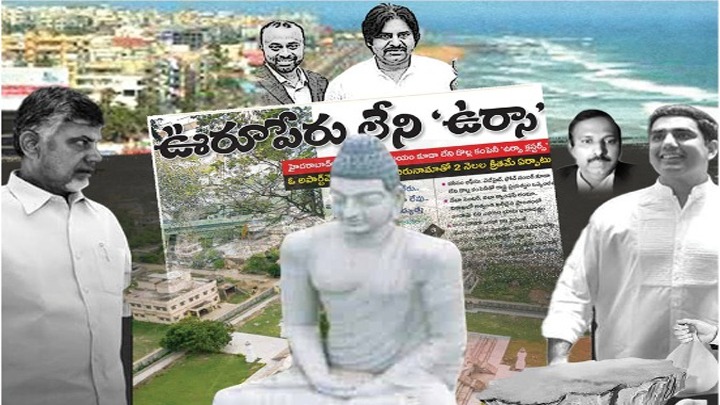
In a brazen display of crony capitalism, the coalition government in Andhra Pradesh, led by the Telugu Desam Party (TDP), has been handing over prime government land worth billions to politically connected entities at throwaway prices. The centerpiece of this scandal is the allocation of 60 acres of land in Visakhapatnam, valued at Rs. 3,000 crore, to Ursa Clusters, a shadowy company incorporated just two months ago, at a jaw-dropping rate of 99 paise per acre. This move is emblematic of a broader pattern of land grabs orchestrated by the coalition government to benefit its allies, relatives, and associates.
Ursa controversy: 3,000 Cr heist?
The allocation of 60 acres to Ursa Clusters has ignited a firestorm of controversy. The decision was formalized during a State Investment Promotion Board (SIPB) meeting chaired by Chief Minister Chandrababu Naidu on April 10, 2025. Ursa, a company with a meager Rs. 10 lakh capital and no significant track record, was granted land worth Rs. 3,000 crore for a nominal price. Ursa is a front for TDP leaders, with names like Nara Lokesh and MP Kesineni Chinni being linked to the firm.
The timeline of Ursa’s rise raises eyebrows. On October 25, 2024, Lokesh visited the United States, reportedly to finalize plans for Ursa’s formation. By February 12, 2025, Ursa was launched in Hyderabad, and its India division was registered on February 19. Barely two months later, on April 15, 2025, the Andhra Pradesh cabinet, again chaired by Naidu, approved the land allocation. The scandal broke into the open on April 19, 2025, but neither Naidu nor Lokesh has addressed the allegations, fueling speculation of a cover-up.
Adding to the intrigue, former MP Kesineni Nani, in a scathing tweet, labeled Ursa a “dummy company” tied to Kesineni Chinni, a TDP MP and his rival. Nani revealed that Ursa’s director, Satish Abburi, is a classmate of Chinni, and the company of ties to fraudulent ventures like Twenty-First Century Investments and Properties. Nani demanded the cancellation of the allocation, but the government has remained silent. On April 21, Ursa claimed it had offered Rs. 50 lakh per acre, a statement that only deepened suspicions, given the vast gap between the alleged offer and the 99-paise deal.
TCS and other beneficiaries: pattern of favoritism
Ursa is not an isolated case. The same SIPB meeting approved 21.16 acres for Tata Consultancy Services (TCS) at the same 99-paise rate, raising questions about the government’s valuation process. Critics argue that TCS, a global IT giant, was used as a respectable cover to slip Ursa’s allocation through. The coalition government’s generosity extends beyond Visakhapatnam, with vast tracts of land across the state being doled out to questionable entities.
In Kurnool’s Orvakal, 1,200 acres worth thousands of crores were allocated to People Tech, a company linked to TG Vishwaprasad, a business partner of Deputy Chief Minister Pawan Kalyan. The land, meant for a “mobility park,” was handed over at Rs. 15-16 lakh per acre, despite market rates of Rs. 80 lakh per acre. Doubts persist about People Tech’s financial capacity to invest the promised Rs. 2,100 crore.
In Nellore’s Naidupeta SEZ, Premier Energies Limited was granted 106.6 acres at Rs. 60 lakh per acre, along with Rs. 1,573 crore in incentives, for a solar PV cell manufacturing unit that will employ just 1,500 people. In Sri Sathya Sai district, Media Matrix Worldwide Limited received 329 acres at Rs. 7 lakh per acre for a defense manufacturing unit, despite the government acquiring the land at Rs. 21.95 lakh per acre, incurring a Rs. 49.18 crore loss.
Perhaps the most audacious allocation was to the Lulu Group. In Visakhapatnam’s Harbor Park, 13.43 acres of beachfront land, valued at over Rs. 2,000 crore, were leased to Lulu for 99 years at a nominal rate. The market value of the land exceeds Rs. 150 crore per acre, yet the government bypassed standard procedures like issuing an RFP notification.
Legacy of land deals
The coalition government’s land allocations are not new. In 2017, during Naidu’s previous tenure, 1,020.5 acres in the Amaravati capital region were allocated to 12 companies, with private firms receiving hundreds of acres on freehold terms, while public entities got smaller plots on lease. In 2018, Karvy Data Management Services received 16.42 acres in Amaravati at Rs. 55 lakh per acre, despite the land’s Rs. 67.32 crore valuation. In Tirupati, Reliance Prolific Traders and Extron Servers Manufacturing were allotted 175 and 5.64 acres, respectively, at far below market rates.
Even Pawan Kalyan, the Janasena leader and Deputy CM, records show he acquired 2.4 acres near Kaja’s Inner Ring Road from the Lingamaneni family at Rs. 8 lakh per acre, a fraction of the market value, with the land conveniently exempted from land pooling.
AI and Drone facade
The government has justified these allocations by touting investments in “AI and drone technology,” buzzwords that resonate with the public. However, critics argue this is a smokescreen to mask real estate ventures and land speculation. Ursa, for instance, has no proven expertise in AI or drones, yet its allocation was fast-tracked under the guise of innovation. The government’s mantra of “invest, grab, and share” has become a rallying cry for detractors, who accuse the coalition of plundering public assets for private gain.
Public outrage and Political fallout
The land scandal has sparked widespread outrage, with opposition leaders and citizens demanding accountability. Kesineni Nani’s public feud with Chinni on social media has exposed internal rifts within the TDP, while the government’s refusal to clarify its actions has only deepened public distrust. The coalition’s 11-month tenure has been marked by a series of controversial land deals, raising questions about its commitment to transparent governance.
As Andhra Pradesh grapples with this unfolding scandal, the question remains: will the coalition government address the allegations, or will the 99-paise land grab become a defining legacy of its rule? For now, the people of Andhra Pradesh are left to wonder how much more of their state’s wealth will be siphoned off under the guise of “development.”