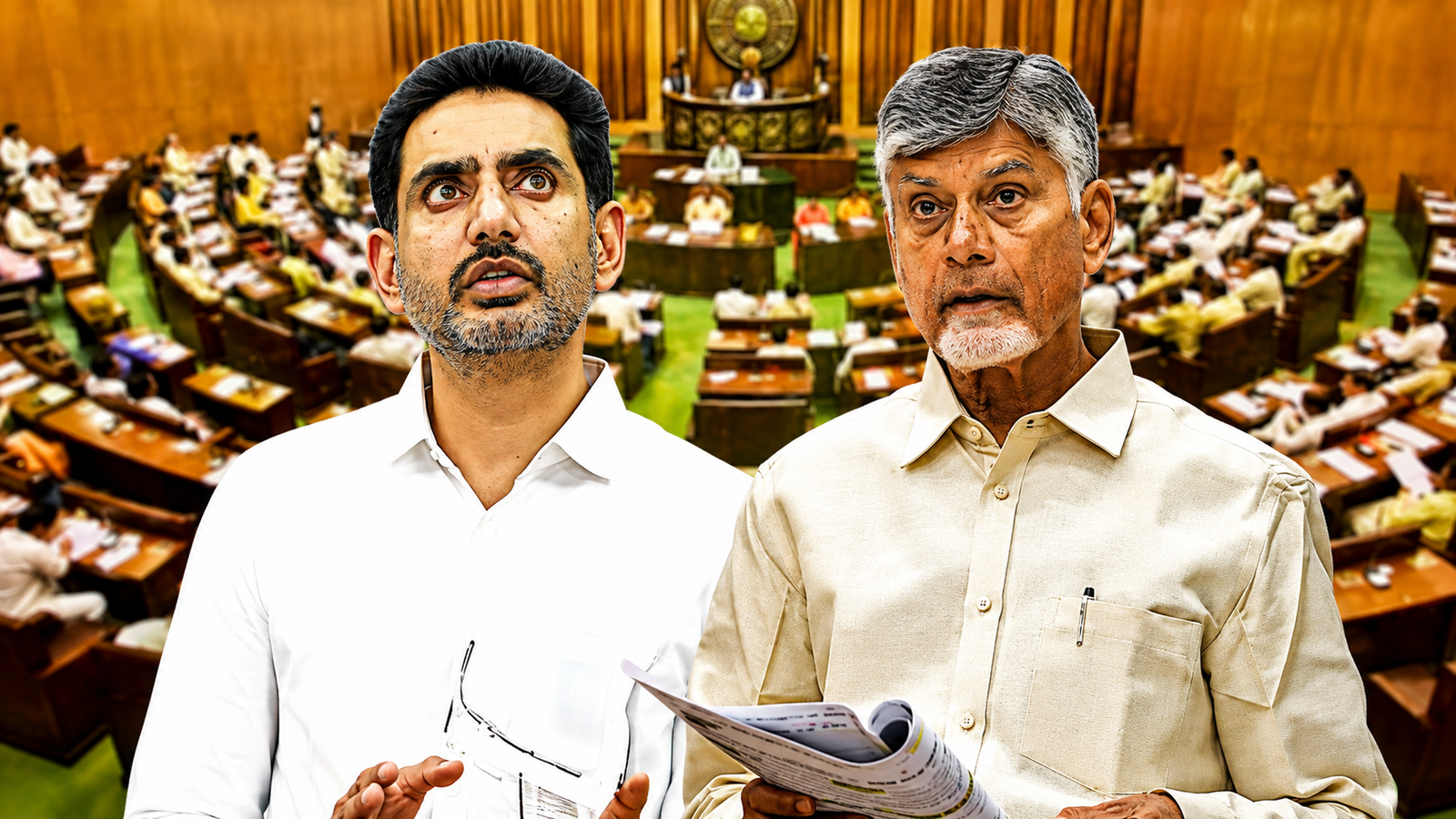
For the past several days, YSRCP has been confronting the government with documentary evidence over irregularities in Mega DSC-2025. During Monday’s Assembly proceedings, Chief Minister Chandrababu Naidu and Ministers Nara Lokesh and Atchannaidu launched a counterattack on the Opposition, but failed to provide direct answers to the specific issues raised by YSRCP. Nor could they produce evidence demonstrating that the recruitment was conducted with complete transparency.
In the Legislative Council, Minister Atchannaidu was caught on the defensive when he asked, “Will you create such a huge controversy even if a small mistake has occurred in DSC?” His statement itself raised questions over whether the government was conceding that mistakes had taken place. At the same time, instead of directly answering YSRCP members in the Council, Chief Minister Chandrababu Naidu and Education Minister Lokesh chose to present their defence in the Assembly.
Lokesh Admits Sports Quota Candidates Were Given Jobs Without a Written Test
Education Minister Nara Lokesh admitted in the Assembly that no written examination was conducted for candidates recruited under the Sports Quota. He defended the decision by comparing it with the special appointment given to P.V. Sindhu without a written examination.
However, the government did not explain how a special appointment granted to an internationally accomplished sportsperson such as P.V. Sindhu could be equated with mass recruitment to government teaching posts.
Physical Education posts may have separate eligibility conditions and may, in certain circumstances, have exemptions from TET. But under the Sports Quota, candidates were also recruited to teaching posts such as SGT, School Assistant and TGT. The government did not clearly explain the legal basis for exempting such candidates from the recruitment examination.
Under the RTE Act, 2009, NCTE norms and State teacher recruitment rules, candidates for the respective teaching posts are required to possess prescribed qualifications such as TET, B.Ed and D.Ed, wherever applicable. Lokesh did not clarify how these statutory and recruitment requirements were bypassed in the name of Sports Quota.
Exemption Through G.O. 47 — Examination Restored Through G.O. 56 After Recruitment
The government issued G.O. 47 allowing Sports Quota recruitment without an eligibility examination. After completing the appointments under that framework, the government withdrew the provision and issued G.O. 56 restoring the requirement of a written examination.
The government did not explain why two different standards were followed for the same category of recruitment. Exempting candidates from the examination until appointments were completed and restoring the examination requirement thereafter naturally raises serious questions.
Why Were Question-Paper Preparation and Examination Conduct Placed Under One Officer?
In previous DSC recruitments, question-paper preparation was handled by the Director of SCERT, while examination conduct was entrusted separately to the DSC Convenor.
The government has not clearly explained why these two highly sensitive responsibilities, which require strict confidentiality and institutional separation, were brought under the control of a single authority in DSC-2025.
What Government Order or official instruction authorised the departure from the earlier system? What checks and balances were introduced during question preparation, digitisation, uploading and examination conduct?
The government’s statement that the entire process was completed within “148 days” only explains speed. It does not establish confidentiality or transparency.
How Did Outsourced SCERT Employee Naveen Secure Rank 1?
One of the most serious questions surrounding DSC-2025 is how P. Naveen, an outsourced employee working in SCERT—the institution where question papers were prepared—secured the first rank.
The government has so far confined its explanation to saying that Naveen did not obtain prior permission to write DSC and that he failed to attend certificate verification.
But it has not answered the central questions.
What exactly were Naveen’s duties in SCERT? Was he connected in any way with question preparation, typing, digitisation or uploading? Were his computer, email and digital access logs examined? Was any departmental, vigilance or independent inquiry conducted?
The government explained why he was ultimately not selected for appointment, but did not establish whether he had access to question-paper information.
There was also no explanation regarding YSRCP’s question that Naveen’s wife had reportedly secured high marks or a good rank.
Naveen’s Login: Lokesh Says One Thing, Officials Say Another
Principal Secretary for School Education Kona Sasidhar stated that Naveen, being an outsourced employee, had not taken prior permission to appear for DSC and was therefore declared ineligible. He also stated that Naveen’s login had not been blocked.
However, Minister Lokesh stated in the Assembly that Naveen’s login had been removed.
The government’s own document records Naveen’s contention before the court that his login had stopped functioning from August 26. The department, however, maintains that no such instance appears in its records.
These contradictory statements can easily be resolved by releasing the portal login logs, call-letter download records, SMS delivery reports and the technical wing’s report. The government has not made these records public.
No Technical Evidence Produced to Support the Claim That Outsourced Employees Had No Access
The government declared that outsourced employees had no access to confidential data. But it did not release system logs, employee duty-allocation orders, CCTV review records, cyber-forensic findings or an independent audit report to substantiate that assertion.
It said only two regular employees uploaded questions into the TCS iON system.
But who were those two employees? In what form did they receive the questions? Who handled the material between question preparation and uploading? Who audited the upload logs? Who maintained the computers used to prepare the questions?
The government explained only the final uploading stage while leaving the entire chain of custody—from preparation to digital transfer—unexplained.
Are 42,000 Questions by Themselves a Guarantee of Confidentiality?
The government said approximately 42,000 questions were prepared across 13 subjects.
But the mere volume of questions does not establish examination security.
Was there an independent audit of question selection, shuffling, allocation across examination sessions and access controls? If such an audit was conducted, where is the report?
When an employee working in the very institution where questions were prepared secures the first rank, it becomes necessary to examine the matter through vigilance, CID, an independent cyber audit or third-party forensic investigation.
The government has not explained why such an investigation was not undertaken. Nor has it disclosed any inquiry report on the basis of which it concluded that there was “no paper leak.”
Why Were the Rules on Display of Merit Lists Not Followed?
When questioned about the non-display of merit and Merit-cum-Roster lists on the notice boards of District Collector offices, the government replied that the lists were published online and SMS alerts were sent.
But if the recruitment rules required physical display of the lists, the government did not explain why that requirement was not followed.
Confusion in Certificate Verification Numbers
The government stated that 16,291 candidates were considered during certificate verification and 15,941 were approved.
The difference between these two figures is 350.
However, in the same presentation, the government also stated that 722 candidates were rejected upon application of the Merit-cum-Roster process.
Are the 350 candidates and the 722 candidates related to different stages? At what stage were the 722 candidates excluded? Were candidate-wise reasons for rejection or non-selection communicated?
The government’s explanation provides no clarity on these numbers.
Injustice Under the 1:1 Verification System
The government itself stated that candidates were called for certificate verification in a 1:1 ratio against vacancies and that some candidates were subsequently excluded after application of horizontal reservations.
If reservations and roster positions were known beforehand, why were they not applied before preparing the 1:1 verification list?
Why were candidates unnecessarily called for verification if they were subsequently going to be excluded? Why was an alternative arrangement such as 1:2 verification not adopted if further adjustments were still required?
These questions remain unanswered.
Lack of Transparency Even in Grievance Disposal
The government said 33,830 queries were received and 1,135 grievances were disposed of.
But how many grievances were decided in favour of candidates? How many were rejected? What were the reasons for rejection? Were the committee decisions made public?
The government also did not explain how committees consisting of officials from the same department could be considered sufficiently independent while examining complaints concerning the recruitment conducted by that department.
Sports Quota Rules Changed One Day Before the DSC Notification
The government changed the Sports Quota framework through G.O. 4 and G.O. 47 just one day before the DSC notification.
Its explanation was limited to saying that 65 sports disciplines were adopted based on a Union Government memorandum.
But why were the rules altered at the last moment? How were new rules applied to a recruitment process that had already been set in motion? Why was the eligibility examination requirement contained in the earlier G.O. 74 removed? How many candidates benefited from this change?
The government also did not clearly state when the earlier G.O. was formally superseded, from what date the new policy became operational, and what legal basis existed for exempting Sports Quota candidates from the written examination.
372 Sports Quota Selections — But Where Are the Verification Details?
The government stated that 372 candidates were selected under the Sports Quota.
But it did not disclose how many sports certificates were examined, how many were rejected, how many confirmations were obtained directly from the issuing sports bodies, how many suspicious certificates resulted in cases, or whether candidate-wise details of sport, medal and level of competition were published.
YSRCP material had referred to approximately 270 appointments in a particular context, whereas the government placed the total Sports Quota selections at 372.
The government did not explain whether the figure of 270 referred to a specific category of appointments and whether 372 represented the total across all managements and categories.
Community-Wise Figures Do Not Answer the Real Question
The government gave the Sports Quota breakup as OC-46, BC-185, SC-112 and ST-29.
These are broad social-category figures.
If the allegation is that an unusually large number of appointments went to a particular caste or sub-group, answering that question requires disclosure by caste or sub-group, sport, district and merit criteria. The government did not provide such data.
The government also did not directly answer the issue relating to appointments under “cards games.”
Was the sport officially recognised? How many candidates were selected under that discipline? At what level had they competed? Had they won medals?
Those details were not provided.
Government Stops With One Arrest in Sports Quota Job-Sale Audio Case
The government said that a case was registered over the audio recording concerning the sale of Sports Quota jobs and that one person was arrested.
But it did not answer whether money was actually collected in the name of securing jobs, whether the arrested person had any connection with SAAP or the recruitment process, whether any candidates involved in the conversations were ultimately selected, or whether the role of officials was investigated.
There was also no comprehensive explanation regarding the allegation that amounts ranging from Rs.15 lakh to Rs.20 lakh were demanded for teacher posts.
The government disclosed no information on the alleged network of agents, complaints received, cases registered, candidates who paid money, or whether any such persons subsequently figured in the selection process.
Dates and Committees, But No Answers to the Core Questions
The government’s presentation contains dates, committee details, website publication schedules and grievance statistics.
But it does not provide evidence-based answers to the principal questions: how an outsourced employee working in SCERT secured the first rank; what his actual duties were; whether he had digital access; what happened between question-paper preparation and uploading; whether any independent cyber or vigilance investigation was conducted; which candidates were affected after 1:1 verification; why Sports Quota rules were changed at the last moment; how sports certificates were authenticated; and whether the job-sale negotiations had any connection with the actual selection process.
Therefore, the government’s document cannot be treated as a comprehensive report that has disproved every allegation with evidence. At best, it remains a departmental explanation that leaves several fundamental questions unanswered.
If the government genuinely wants to remove all suspicion surrounding DSC-2025, it must facilitate an independent investigation and place in the public domain the system logs, audit reports, candidate-wise reasons for selection and rejection, and the complete verification records of Sports Quota certificates.