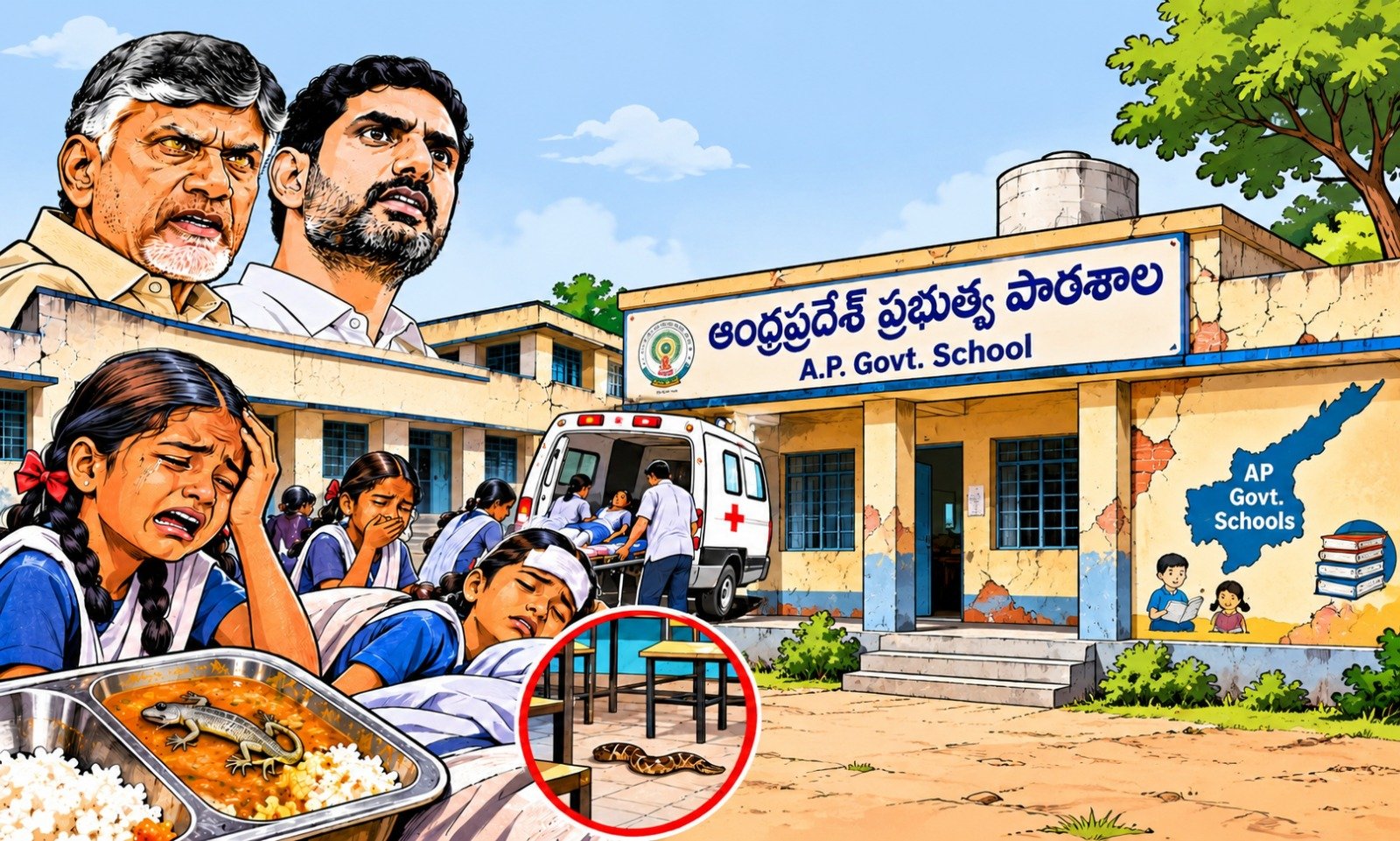
Under Chandrababu’s Rule, schools send Children to Hospitals
From mass food poisoning and snakebites to electrocutions and student deaths, government schools and residential hostels across Andhra Pradesh have become symbols of administrative neglect. As tragedies mount, Chief Minister Chandrababu Naidu and Education Minister Nara Lokesh must answer for the collapse of student safety.
When Education Becomes a Threat to Life
Parents send their children to schools believing education will secure a better future. For thousands of poor and tribal families in Andhra Pradesh, government residential schools and hostels are their only hope.
But under the Chandrababu Naidu government, that hope is increasingly turning into fear.
Instead of receiving updates about academic progress, parents are receiving distressing news of food poisoning, mass illnesses, snakebites, electrocutions and deaths. Children sent to classrooms are ending up in hospital beds. Some have never returned home.
These are not isolated incidents. Across districts, the same failures continue to surface, exposing a government that cannot guarantee even the most basic necessities: safe food, clean drinking water, timely medical treatment and secure accommodation.
The question is no longer whether individual institutions have failed. It is why the Chandrababu government continues to allow the same failures to recur.
80 Girls in Kurupam, 120 in Thondur: A System in Crisis
On November 7, 2026, at the Tribal Welfare Residential Girls’ School in Sivannapeta, Kurupam mandal, Parvathipuram Manyam district, 80 girls suffered from fever, cough, cold, headaches and diarrhoea. Around 50 students were taken to the Mondemkhal Primary Health Centre, approximately 10 kilometres away. Former Deputy Chief Minister Pamula Pushpa Sreevani found sick students accommodated in two rooms during her visit. Even after ten days, the students’ prolonged illness raised serious questions about medical supervision, food safety and drinking water quality. This was not the first warning. Two girls from the same institution had died earlier.
On September 27, at the Ambedkar Girls’ Residential School in Thondur, Kadapa district, 120 students fell ill after dinner. Twenty required hospitalisation, while another 100 received treatment on campus. The principal explained that egg curry had been served because the contractor had failed to supply vegetables. If authorities cannot ensure regular food supplies for residential students, what exactly are they supervising? That same day, a lizard was discovered in the sambar served at the Government Women’s Junior College in Tuni. Nineteen students developed vomiting and required hospitalisation. Parents were not promptly informed. Is protecting institutional reputation more important than informing parents that their children are in hospital?
Food that Should Nourish Is Sending Children to Hospitals
The crisis extends well beyond these incidents. On July 26, 41 girls at the Somulagudem Tribal Residential School fell ill after leftover dal from lunch was served for dinner. At Kotavuratla KGBV, 30 girls suffered vomiting and diarrhoea after leftover vegetables were served at night. Home Minister Vangalapudi Anitha had attended a parents-teachers meeting at the institution that day. On August 5, a lizard was found in ragi malt served at Devarreddipalem Primary School in Prakasam district. Ten children required medical attention. At Devipatnam Tribal Residential School, 103 boys became ill after consuming improperly cooked idlis and chutney prepared from old gram flour. Five students fell ill after eating food containing a lizard at a municipal school in Punganur. Another 11 were hospitalised following a food-related illness at Pedabayalu Eklavya Residential School. The problem extends to higher education. At Kadapa Government Dental College, 30 female students became ill after eating chicken served in their hostel. In Tirupati, more than 78 students across SV Ayurvedic College, SVIMS and Sri Padmavathi Women’s Medical College experienced vomiting and diarrhoea. From primary schools to medical colleges, the pattern is unmistakable. Food safety has become a recurring casualty of administrative negligence.
Children Are Dying While the Government Looks Away
The failures are not limited to mass illnesses. On August 31, 12-year-old Thallam Jahnavi, a seventh-grade student at the Kothulagutta residential school in Kunavaram, died after falling ill. She was initially taken to hospital following vomiting, brought back to the hostel and placed in a sick room. Her condition deteriorated the following morning. She died in an ambulance while being transferred for further treatment. Her grieving parents questioned why they had not been informed earlier. On August 28, 12-year-old Pangi Dinesh, a student at the Eklavya School in Gudem Kotha Veedhi, died from malaria while being transferred to hospital. At Gollaguppa, seven-year-old Madavi Jamuna died after chloroquine tablets were administered as part of malaria-prevention measures. Numerous children and villagers also became ill. The Supreme Court treated the incident with exceptional seriousness, calling for a thorough investigation and transferring further proceedings to the Andhra Pradesh High Court. These tragedies demand more than condolences. They demand a complete examination of medical protocols, emergency response systems and accountability.
Snakebites and Electrocutions: Even Classrooms Are Unsafe
On August 8, 13-year-old Chechu Lakshmi Parvathi died from electrocution at the Sivakasipuram Tribal Girls’ School in Eluru district when an iron window became electrified. Another student also suffered an electric shock. On September 27, Rajitha, a 16-year-old student at Nimmannapalle Model School, sustained serious injuries after coming into contact with electrical wires near a window. At Ragulapadu Tribal Residential School, ninth-grade student Tulasi Naik was bitten by a snake while sleeping inside his hostel room. At Ravada-Ramabhadrapuram Tribal Ashram School, fifth-grade student Pattika Abhi was also bitten by a snake. Overgrown vegetation surrounding the premises had become a serious safety concern. Electrical inspections, clearing vegetation and securing hostel rooms are elementary responsibilities. Why must a child suffer an electric shock or a snakebite before officials recognise a dangerous environment?
A Mental Health Crisis That Cannot Be Ignored
At Anasabhadra Eklavya School, students complained about inadequate food quantity and quality, with 346 students affected by the institution’s food arrangements. The problems came under scrutiny following the suicide of seventh-grade student Savara Anil. On September 24, 16-year-old Bhavya died by suicide at Kothapalli KGBV in Nandyal district. Her family questioned the conduct of staff and delays in communicating her condition. On November 3, intermediate student J. Ushasri died by suicide at G. Kothapalli KGBV in Anakapalli district. Preliminary police findings pointed to academic pressure, while her earlier suicide attempt demonstrated the need for sustained psychological support. Students need counsellors, accessible grievance mechanisms and adults who listen when they are struggling. A residential school cannot claim to provide education while neglecting students’ emotional well-being.
Chandrababu and Lokesh Cannot Escape Responsibility
Every incident exposes failures in supervision, infrastructure, sanitation, medical preparedness or student welfare. Every repeated incident exposes something bigger: a government that has failed to correct those failures. Chief Minister Chandrababu Naidu cannot shift responsibility entirely onto wardens, principals or contractors when similar incidents continue across the state. Education Minister Nara Lokesh must explain why student safety remains so fragile under his administration. While Lokesh remains occupied with political affairs beyond his department, serious deficiencies within the education system demand his immediate attention. The educational reforms introduced during Y.S. Jagan Mohan Reddy’s tenure is being undermined as the present government allows public educational institutions to deteriorate. Every government residential school, tribal hostel, KGBV and college hostel requires comprehensive safety inspections, reliable medical supervision, food and water testing, electrical audits and transparent reporting to parents. Officials must be held accountable, and deficiencies must be corrected before another tragedy occurs. Parents do not send their children to government schools to become victims of neglect. They send them to study, grow and return home safely.
Children’s lives are more important than the government’s image.
Chandrababu Naidu and Nara Lokesh must answer a question that families across Andhra Pradesh are now forced to ask: If the government cannot protect children inside its own schools and hostels, what is the value of its promises about their future?