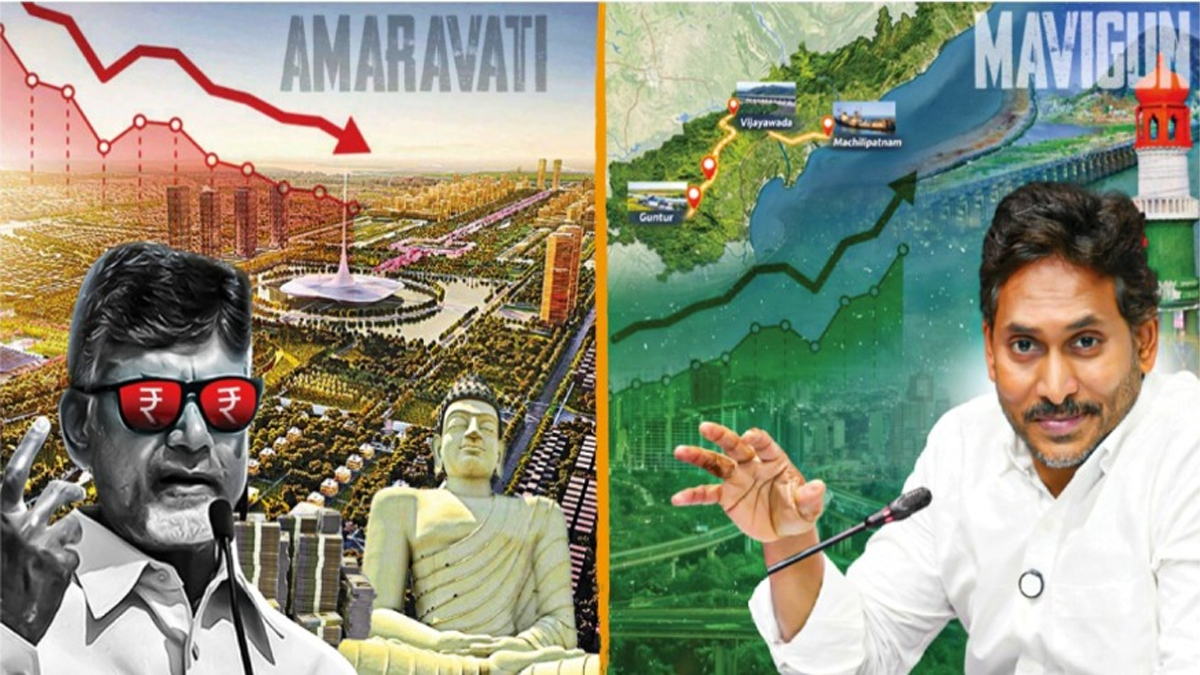
Across Andhra Pradesh, a major debate is unfolding—Amaravati vs MAVIGUN. People are increasingly questioning whether it is justified to burden the state with Rs.2 lakh crore in debt in the name of Amaravati, when a capital vision can be realized with just 10% of that cost through the MAVIGUN model (Machilipatnam–Vijayawada–Guntur corridor).
Core Debate: Burden vs Growth Engine
While Amaravati remains a greenfield project requiring massive investments, MAVIGUN already functions as an economic corridor with existing infrastructure, population, and economic activity. Amaravati needs huge capital infusion, whereas MAVIGUN is already generating wealth. Amaravati requires migration and population buildup, but MAVIGUN already has a strong urban population base. Amaravati is geographically limited, while MAVIGUN naturally expands across regions. Amaravati is still under construction, whereas MAVIGUN already has roads, railways, a port, and an airport. Development in Amaravati will take years, while MAVIGUN already has strong educational institutions and a skilled workforce. One model depends heavily on funding, while the other grows organically. Amaravati increases the debt burden on the state, whereas MAVIGUN offers an opportunity to reduce financial strain on people. Amaravati is seen as a real estate-driven capital, while MAVIGUN represents an economic growth corridor. Amaravati is confined to a few villages, while MAVIGUN is a dynamic powerhouse spanning three districts. Amaravati covers about 217 sq. km, whereas MAVIGUN spans 9,536 sq. km. Experts clearly state that a capital should be built where economic activity exists, not in an imagined space.
Comparison Table: Amaravati vs MAVIGUN
| Parameter | Amaravati | MAVIGUN |
| Model | Greenfield Capital | Existing Economic Corridor |
| Investment Need | Very High (Rs.2 lakh crore) | Low (≈10% of Amaravati cost) |
| Economic Activity | Yet to develop | Already generating wealth |
| Population | Needs migration | Existing urban population |
| Geography | Limited | Naturally expanding |
| Infrastructure | Under construction | Roads, Rail, Port, Airport already present |
| Growth Model | Funding-dependent | Organic growth |
| Debt Impact | High burden | Reduces financial strain |
| Nature | Real estate-driven | Economic growth-driven |
| Area | 217 sq. km | 9,536 sq. km |
| Coverage | Few villages | Three districts powerhouse |
From Political Debate to Economic Analysis
This debate has now moved beyond politics into economic analysis. While Amaravati represents a greenfield administrative capital model, MAVIGUN is viewed as an economic corridor built on existing cities, industries, and transport networks. Experts argue that when comparing economic strength, population density, infrastructure, and scalability, MAVIGUN offers a far more viable and sustainable model for the state’s future.
Geographical & Demographic Strength
The geographical and demographic contrast is stark. Amaravati’s core capital region is about 217 sq. km, while MAVIGUN spans across NTR, Krishna, and Guntur districts with a combined area of 9,536 sq. km. The population of these three districts stands at approximately 6 million, indicating an already established urban and economic base, eliminating the need to attract new populations artificially.
Economic Strength: A Ready Growth Engine
Economically, MAVIGUN is already a strong growth engine. For the financial year 2025–26, the combined GDP is estimated at Rs.2,87,592 crore, contributing around 16% to the state’s economy. The region has a balanced economic structure across services, agriculture, and industry, ensuring stable and sustained growth.
Income Strength
Per capita income also reflects this strength, with Krishna district at Rs.4,82,078, NTR at Rs.3,91,390, and Guntur at Rs.3,28,534, indicating strong income-generating potential driven by a balanced economy.
Infrastructure Advantage
In terms of infrastructure, MAVIGUN is already well-positioned with:
- Machilipatnam Port (Rs.5,156 crore project)
- Vijayawada Railway Hub (major national junction)
- Gannavaram Airport (1.06 million passengers annually)
Together, they form a Port–Rail–Air logistics triangle, a major investment magnet.
Education & Human Capital
The region has strong institutional support with:
- Acharya Nagarjuna University
- Dr. NTR Health University
- Krishna University
- AIIMS Mangalagiri
This ensures availability of skilled workforce and governance capacity.
Future Economic Projections
Future economic projections further strengthen the case for MAVIGUN. While Amaravati’s proxy GDDP (based on Guntur) stands at Rs.83,618 crore in 2025–26, MAVIGUN is already at Rs.2,87,592 crore. By 2035–36, Amaravati is projected to reach Rs.2,37,427 crore, whereas MAVIGUN could reach Rs.8,93,217 crore. By 2045–46, Amaravati may reach Rs.6,74,154 crore compared to MAVIGUN’s Rs.27,74,197 crore, and by 2055–56, Amaravati could reach Rs.19,14,208 crore while MAVIGUN may grow to Rs.86,16,234 crore. These projections suggest MAVIGUN could be 3.4 to 4.5 times larger economically than Amaravati.
| Year | Amaravati | MAVIGUN |
| 2025–26 | Rs.83,618 Cr | Rs.2,87,592 Cr |
| 2035–36 | Rs.2,37,427 Cr | Rs.8,93,217 Cr |
| 2045–46 | Rs.6,74,154 Cr | Rs.27,74,197 Cr |
| 2055–56 | Rs.19,14,208 Cr | Rs.86,16,234 Cr |
MAVIGUN is projected to be 3.4x to 4.5x larger economically than Amaravati.
Conclusion: Where Should a Capital be built?
In this context, experts emphasize that capital development should not be driven by political imagination but by economic viability. Building a capital on an existing economic ecosystem is far more sustainable than creating a new city from scratch. This is why the debate—Amaravati vs MAVIGUN—is gaining momentum across the state, with people increasingly questioning which model represents a burden and which truly serves as a growth engine.